
 Copy Reference
In March, the spring wind caresses people's faces and ushers in the two annual sessions in Beijing, the sessions of the National People's Congress (NPC) and the Chinese People's Political Consultative Conference (CPPCC), which are held almost at the same time during the first and second ten-day periods of March every year.
The two sessions are important events in China's political life. Deputies to the NPC, shouldering the great trust of the people of various ethnic groups and from all circles, deliberate and vote on the major plans and policies. The CPPCC delegates perform the function of political consultation by participating in the administration and discussion of State affairs and making suggestions.
The two sessions of 2016 focus on the 13th Five-Year Plan. From 1953, a Five-Year Plan has been made annually to decide upon the major construction projects and important issues concerning the national economy and set objectives and direction for the long-range national economic development. By 2015, 12 Five-Year Plans had been completed. The 13th Five-Year Plan lasts from 2016 to 2020. Thus, the year 2016 sees the heavy task of formulating the development plan for the five years to come.
On Nov 3, 2015, the 5th Plenary Session of the 18th CPC Central Committee was held, and one major item on its agenda was deliberating on and approving the proposal of the CPC Central Committee for the 13th Five-Year Plan for economic and social development (2016-2020). The Proposal determines the guiding principle, objectives, tasks and major initiatives for China's economic and social development during the five-year period and establishes a master plan for China's development in that time. This Proposal will be deliberated on by the NPC in March and become a formal program document guiding China's economic and social work after being adopted.
This Proposal provides a new blueprint for completing the building of a well-off society in an all-round way and puts forward five major principles of innovative, coordinated, green, open and inclusive development. The five major development principles serve as the development thought, direction and focus in the period 2016-20 and even longer, and also represents an epitome of China's development experiences accumulated in over 30 years of reform and opening up.
From the five major development principles, one can find clues to how China will complete the transformation of its economic development mode and realize the established strategic goal of completing the building of a moderately prosperous society in an all-round way by 2020.
Innovation Increases Endogenous Impetus of Economy
By Zhang Lijuan
The Proposal of the CPC Central Committee for the 13th Five-Year Plan for economic and social development (2016-2020) explicitly proposes to set innovation as the development basis to formulate the institutional structure of innovation, develop more leading development depending on innovation and draw on the first-move advantage amid rising competition in the world and transformation of the impetus in Chinese development.
Past Five-Year Plans failed to set innovation as an independent concept. The Proposal has far-reaching connotations in giving more importance to innovation.
New Planning
Thanks to this concept, efforts will be made to foster new impetus to development, seek more room for development, implement an innovation-driven development strategy, promote agricultural modernization, build a new industrial system, establish a new system for development, and seek a new approach to improve macro-regulation. In effect, these efforts combined form a response to the question of the basic motive forces for future economic development in China.
According to Wang Jun, Deputy Head of the Department of Information in the China Center for International Economic Exchanges (CCIEE), “innovation” was not independently expounded in previous Five-Year Plans, a deficiency that is now being dealt with. It is more than the traditionally narrow sense scientifically and technologically. Instead, at the national and strategic level, it offers broad strategic, systemic and comprehensive meaning in many aspects and at many levels of theory, system and mechanism, mode of development, science and technology and social management.
According to Wang: “Planning is, as a matter of fact, based on the more drastic international competition and the new normal in China's economic development. In this circumstance, what provides the impetus for economic development? Only innovation increases the endogenous impetus of the economy”.
For quite some time, the economic and social development in China has mainly been supported by cheap land, resources, energy, and labor forces. Nowadays, resources and the environment have become increasing constraints. The demographic dividend is gradually declining. Labor costs have risen sharply, and interest rates have gradually declined. The original competitive edge evidently has weakened, and the driving force for development has apparently degenerated. It no longer works to develop simply relying on increasing the labor force and other element inputs. It is necessary to inject new impetus to the economic development by strengthening the comprehensive efficiency of innovation and elements of input.
New Connotation
Innovation in the Proposal doesn't simply mean to take enterprises as the main force in a narrow sense. Instead, every member of society constitutes an active mainstay of innovation. It invigorates innovation across a broad front in society, gives full play to the government's leading role, and stimulates the sense and practice of innovation of enterprises, individuals, social organizations and all kinds of civil groups.
“Among numerous innovations, that in theory is the core. It is the need of social practice and the fundamental guarantee for an organization and an enterprise to maintain their vigor to win amid fierce competition,” said Wang.
As the economy booms in China, some deep-rooted contradictions have gradually emerged. In the future, growth will slow down amid the worsening global economic environment. In the coming 13th Five-Year Plan, or even longer, economic and social development in China will still face all kinds of sharpened structural contradictions. With these new pressures brought on by the new changes in the international economic environment, a more systemic and comprehensive way of innovation is needed to promote development.
According to Wang Jun, efforts should be made to transform the economic development mode, and make new approaches in structural transformation, operational quality, economic efficiency, income distribution, environment protection, degree of urbanization, level of industrialization and the overall modernization process.
Innovation in science and technology reflects the core competitive edges of a country. It is the chief means of promoting economic development. Over the past 30 years of development, China has given full play to the comparative advantages of its labor force, but science and technology has failed to make satisfactory contributions, becoming a bottleneck to further development.
During the 13th Five-Year Plan, China will accelerate improvement of its comprehensive technological innovation system that brings together government, enterprises, academia and research institutes so as to enhance the inner dynamics and capability for technological innovation of the enterprises.
Also, China will deepen reform of the scientific and technological system, improve the development mechanism, and effectively bring into play the pioneering role of research institutions to build an innovation-oriented country.
New Society
In addition, social management policy is included, for the first time, as a way to resolve the “economic issues”, thus becoming an important factor for “economic growth”.
According to Yang Weimin, Deputy Director of the Office of the Central Leading Group on Financial and Economic Affairs, when formulating the short-term macro-regulation policy and medium and long term planning for economic and social development, we need to include the social security system. Thus, we will continue to deepen reform of social undertakings, especially in regard to the education system, medical and health care system, and culture system related to people's livelihood. We will work to establish and improve the system and mechanism for the coordinated development of competitive and mass sports, and improve the social management system at the grassroots level, seeking to ensure that everyone can enjoy their right to education, employment, medical and old-age care, and housing, so as to build a harmonious society.
It is obvious, therefore, that innovation emphasizing both technology and morality will be important in the 13th Five-Year Plan. Advanced science and technology, unique patented inventions, and unprecedented products, organizations, industries, business formats and markets are all indispensable. Morality contains more flexible strength, such as innovation concept, ideology, environment, policy, rules, system, laws and human resources. Only by integrating the two aspects can the sense of innovation go deep into every vein and cell of the economy and society to become the daily nutrition for national progress. In the final analysis, innovation is not only related to science, technology, and economy, but also to humanity and society. It works to change the world and our life so as to create a better world.
Nowadays, innovation has become the main theme of this era and the strongest voice of China. It is regarded as the key driving force for social development. To achieve the goals set in the 13th Five-Year Plan, China will aspire to achieve innovative, coordinated, green, open and shared development. With innovation as the starting point and people's sharing as the goal, we will always stick to popular entrepreneurship and innovation.
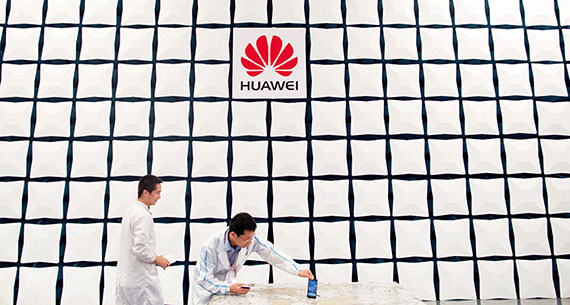
The product laboratory of Huawei Technologies in Shenzhen
Coordination Aims to Address Unbalanced Development
By Wang Zhe
Since 2011, when the 12th Five-Year Plan started, China has seen remarkable socio-economic development. As the second largest economy, it has grown into the world's biggest commodity trader and a major foreign investor. Income of its rural and urban residents has achieved annual average growth of nearly 10 percent.
Despite that, unbalanced, uncoordinated and unsustainable development remains a pronounced problem. There are 70 million poverty-stricken people in the rural areas, an imbalance in economic and social development. To resolve the problems, the Chinese government advocated emphasizing coordinated development of urban and rural areas, promoting coordinated development of the economy and society, and developing the new types of industrialization, applications of information technologies, urbanization and agricultural modernization. While enhancing the country's hard power, it also eyes soft power for overall development.
Zhang Zhanbin, Director of the School of Economics in the Chinese Academy of Governance, made this comment: “In the past, we kept stressing ‘coordinated development’. Now, we put this concept in an even higher position, which will have a big bearing on adjusting the development of the economy and society across the country. Also, this puts forward new requirements for development during the 13th Five-Year Plan.”
Coordinated Development in Six Aspects
In an interview, Professor Xu Yaotong from the Chinese Academy of Governance said: “Faced with pressures under the new normal in economic development, coordinated development is the key to solving problems. Coordination means to take all aspects of the complicated affairs into account without stressing one side while neglecting another.”
According to Xu, coordinated development needs a global viewpoint and comprehensive consideration. The key lies in coordination to ensure balance between rural and urban areas, and between eastern and western regions. Only in this way can China reflect the reality of its unbalanced development.
Zhong Jun, Director of the Department of Economic and Social Construction in the Chinese Academy of Social Sciences, observed: “At present, the social structure sees a mismatch in the economic structure, as the structure of employment, urban areas, social classes, population and family do not match that of industries and consumption patterns. As a result, the wealth gap extends from the economic area to society, and the gaps in the economic resources are matched by those in social resources.”
Coordinated socio-economic development needs to reflect and keep pace with development of new types of industrialization, applications of information technologies, urbanization and agricultural modernization.
Wang Jun, Deputy Head of the Department of Information in the China Center for International Economic Exchanges (CCIEE), believes “the concept of coordinated development must emphasize its integrity, even though some fields develop at a faster speed. In particular, some achievements or the faster speed in their development were made in the past at the expense of environment and people's well-being. Coordinated development means to keep a close eye on the new normal of economic development, and to make up for missing or weak elements in an effort to gain balance and coordination.”
Remedying Barrel Principle's Short Boards
According to the proposal outline for the 13th Five-Year Plan, as of 2020, the target is to build a moderately prosperous society: Agricultural modernization will make remarkable achievements; people's living standards and quality of life will be generally improved; poverty-stricken people in rural areas will shake off their backwardness under the current standard set in China and regional poverty will be reduced as a whole.
In modern management terms, the Barrel Principle tells us that the capacity of a barrel depends on the shortest, rather than the longest, board. The 13th Five-Year Plan proposal especially emphasizes the concept of coordinated development, focusing on extending the short boards in the period, including providing basic public services equally to different regions, and equally to rural and urban areas, and balanced allocation of public resources. To be specific, public services should be ensured in the aspects of water and gas supply, roads, electricity, elderly care, health care and education.
In the future, targeted measures to help people lift themselves out of poverty will focus on employment transfers, relocation and full inclusion into the basic living allowance arrangements to help 70 million rural people to shake off poverty. Efforts will also be made to continue to have industry nurturing agriculture, urban areas supporting rural areas, improving the system for integrated development in urban and rural areas, and promoting equal exchanges and rational allocation of rural and urban elements. In particular, the pace will be quickened to provide basic public services to urban and rural areas in an equitable way, making it possible for everyone to contribute to and share in the fruits.
According to Xu Yaotong, “for coordinated development, we need to pay attention to development as a whole. This means we must expand unilateral development into multilateral development and remedy the existing short boards in as many fields as possible. Only in this way can we improve the efficiency of development and keep the achievements steady. When defining a moderately prosperous society, the key is to observe the condition of farmers.”
The overall economy in China will grow more robust once the short boards in rural areas and in the West are remedied. To develop new types of industrialization, applications of information technologies, urbanization and agricultural modernization at the same pace and enhance the country's soft power, coordinated development will ensure a moderately prosperous society in an all-round way. Coordinated development in rural and urban areas will help ensure economic restructuring and alleviate the economic downward pressure.
Pursuing Premium Equilibrium Concept
On this vast land of China, different regions inevitably develop in different degrees. Data shows that, although the widening trend is effectively restrained, the gap in regional development remains large compared to developed countries. GDP per capita in higher-income regions is five or six times of that in lower-income regions, while this figure is generally no more than two or three in developed countries. Data indicates that bridging the regional gap among the East, the middle and the West is almost equal to the growth across the country.
Imbalanced and uncoordinated development needs to be researched and resolved in a more targeted way during the 13th Five-Year Plan. “Coordination” means joint efforts, an even match and appropriate cooperation. It needs dynamic and premium balance, instead of emphasizing “even” only. Development at the same pace permits slow progress within a certain range, rather than the biased or evenly-shared achievements so far. Gaps and differences in development do exist and cannot be ignored. The key to tackle them is to hold them within an appropriate range.
Zhang Zhanbin stressed that efforts must be made to balance the development structure and promote coordinated development among regions and between rural and urban areas. By way of enhancing the quality and efficiency of development, economic growth is strengthened in a real sense to achieve coordinated speed, growth, quality and benefit.
During the 13th Five-Year Plan, the concept of regional governance will be officially introduced. Guided by the economic integration among administrative regions, governments, associations, companies and residents will all join in the efforts on regional planning, regional coordination, administrative division adjustment and regional legislation, in an attempt to achieve the goals of industrial collaboration, infrastructure connectivity, eco-environment protection and allocation of elements promoting market mobility.
Since the beginning of the 21st century, China has carried out the balanced development strategy, including large-scale development of the western region, fully revitalizing old industrial bases in northeast China, and working vigorously to promote the rise of the central region. In the future, in the major push to implement the Belt and Road Initiative, the new pattern of full opening-up will be forged both on the land and in the sea, and both in the eastern and the western regions.
Efforts will be redoubled to push the orderly and free flow of elements, promote effective constraints of the main functions, provide basic public services in an equitable way, and enhance the bearing capacity of resources and environment, giving impetus to the new pattern of regional coordinated development.
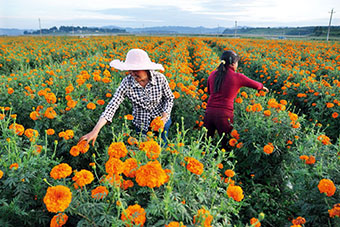
Farmers harvesting marigolds in Bijie, Guizhou Province
Green Adds Color to ‘Beautiful China’
By Wang Fang
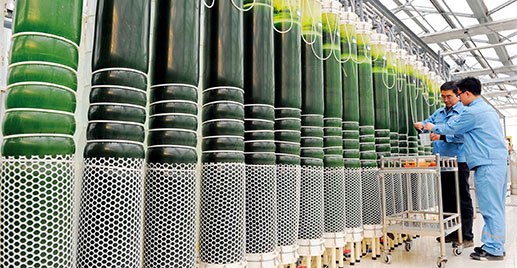
Technicians conducting routine tests on the microalgae in the growth phase at the Shijiazhuang Refining Microalgae Breeding Demonstration Base, the first to use carbon dioxide of refinery as the carbon source in China. The amount of carbon dioxide absorbed by organisms is 10-50 times that by forest. The microalgae can be used as fundamental raw materials for biodiesel, thus are recyclable
The Proposal of the CPC Central Committee for the 13th Five-Year Plan for economic and social development (2016-2020) –hereinafter referred to as “the Proposal” – clearly stated: “To achieve green development, we should uphold the basic State policy of saving energy and promoting environment conservancy, persist in sustainable development, and firmly march along the development path of developed production and a life of well-being in a good environment, so as to set up a new pattern of modern construction with harmonious development between humans and nature, pressing on with the construction of a ‘beautiful China’ and make contribution to global ecological security.”
The proposal devoted much space to fitting general improvement of ecological and environmental quality into the vision of building a moderately prosperous society. Green development has been listed as one of the five major development concepts in the Proposal. A green approach will be the dominant tone in economic and social development in the future.
Green Development
Xu Shaoshi, head of the National Development and Reform Commission (NDRC), observed: “Green development is a common public concern. It is also an important issue concerning sustainable development. ” Currently, water, air and land pollution are outstanding issues we have to deal with.
Along with economic and social development, the environmental issue is becoming an obvious bottleneck in building a moderately prosperous society. A traditional extensive style of economic growth brought great achievements in China's economic and social development, which has also led to increasing severe constraints on national energy resources and the environment.
Official figures showed that few of China's 161 cities reached the desired standard of air quality in 2014. About 19.4 percent of the checkpoints of arable land were badly affected, and the underground water of nearly 60 percent of the cities was of low quality.
China ranks first in energy consumption and carbon emissions in the world. Over the past decade, these two increments accounted for 50 and 60 percent of the world total respectively, and its per capita carbon emissions reached 600 million tons, a third higher than the world level.
Kang Yanbing, the director of the Energy and Sustainable Development Research Center of the Energy Research Institute of NDRC, stressed: “This means we can hardly maintain the development model with high energy consumption, high carbon emission and high pollution. We have to embark on a new path.”
Actually, green development has been gaining increased attention. China had taken actions to tackle the wide range of environment issues and sought to control the various pollutants. Dealing with smog has been the focus in recent years. In 2013, the State Council issued the Action Plan on Air Pollution Prevention and Control. By 2015, China had begun implementing stricter environmental protection regulations while many key areas, such as Beijing, Tianjin, Hebei and their surroundings, as well as the Yangtze River Delta Region, also formulated corresponding action plans.
China has certainly made progress in energy saving and environmental protection. The first four years of the 12th Five-Year Plan saw energy consumption drop by 13 percent, water consumption by 24 percent, and carbon dioxide emissions by 15 percent. Chemical Oxygen Demand (COD), ammoniac nitrogen levels in water and sulfur dioxide emissions have decreased sharply and the total amount of pollutant discharge effectively brought under control. A series of measures are to be adopted in the 13th Five-Year Plan to strengthen environmental protection and ecological construction, so as to achieve green development.
Finance Guaranteeing
The proposal included institutional innovation for green development and the improvement of the environment.
Green development needs capital, so the proposal included “developing green finance and establishing a green development fund”. That offers good opportunities for the overall development of green finance.
Experts have suggested that the national financial department should, as one of its basic policies, stress the importance of environmental protection and pollutant treatment in financial activities and enhance green development by guiding the relevant economic resources to achieve results. Moreover, efforts should be made to further clarify the key tasks of green financial reform during the 13th Five-Year Plan, promote breakthroughs in key fields, such as establishing green banks, green funds and developing green bonds, etc.
The proposal also stated clearly “the need to strengthen targeted management to control energy, water and land resources. Work should be done to implement the action plan for energy conservation, so as to improve standards in regard to energy, water, land, material and mineral conservation, and lead the way of energy and water efficiency. These measures will help save energy, water and land resources and reduce pollutant discharges at source,” as pointed out by Yang Duogui, director of the Institute of Policy and Management of Chinese Academy of Sciences. He further stated “the need to press on with the transformation of the economic growth model and improve China's economic green development”.
Path for Green Development
China is now faced with a great challenge of how to balance economic development and environment protection, and how to gain more development outcomes at lower cost in terms of energy and carbon emission. More efforts need to be made in this regard.
In regard to green development, Kang Yanbing has his own interpretations. He said that low carbon development focused on efficient and clean use of energy. The burning of fossil fuel produces more than 90 percent of carbon dioxide of the total emission in the world, hence the core of any low carbon development has to focus on energy, i.e., we should support economic and social development with less and cleaner energy. Circular economic development emphasizes comprehensive and recycled energy utilization, as well as terminal treatment of regional pollutants and promotion of ecosystem construction to protect the environment.
“Low carbon development will become an increasingly important index because it is not a universal concept. For China, achieving low carbon development will promote energy saving and prioritize the energy consumption structure, as well as helping to deal with air pollution,” said Kang.
He further explained that, if we do a good job of low carbon development, and then focus on end-of-pipe treatment and ecological construction, we may achieve green development and promote China's sustainable development under the restrictions of environment and resources protection.
China will adopt three measures for environment protection and ecological construction during the 13th Five-Year Plan. First, to implement low carbon development, increase the proportion of non-fossil energy, and encourage the use of clean coal in order to build a clean, low-carbon, safe and efficient energy system. Second, to promote efficient resource use, strengthen management of obligatory targets, and manage in terms of both amount and intensity. Third, to adopt market measures in energy management by setting criteria on water, energy and land consumption and allow transactions in water rights and carbon permits.
Benefit for All
Many phrases in the proposal, such as “the general improvement of environment quality” and “centering on the improvement of environment quality”, are closely connected with the life of common people. Green development is designed to share the “green benefits” with all the people.
According to Yang Duogui, “to reach the goal of general improvement of environmental quality by 2020, we need to work hard for the building of ‘a beautiful China’ in the following five years”. That means making more efforts to protect the environment, and invest more resources and strengthen governance capacity to protect forest, grassland, rivers, lakes, wetlands and the ocean.
Building “a beautiful China” will also bring benefits to the world. China's Belt and Road Initiative is a program to promote the welfare of humankind, sustainable development of the world and improvement of global governance system.
The proposal put forward the idea of “making new contributions to global ecological security”, showing that China is active in tackling climate change and living up to its responsibilities in protecting the global environment.
Pragmatic Cooperation Sees China ‘Go Global’
By Wang Yin
Opening up is one of the five major principles of the proposal of the CPC Central Committee for the 13th Five-Year Plan for economic and social development (2016-2020) for National Economic and Social Development (hereinafter referred to as the proposal). As explained by Xu Shaoshi, Director of the National Development and Reform Commission of China, the Chinese economy has grown inseparable with the world economy.
“During the 13th Five-Year Plan, efforts must be made to develop the open economy at a higher level, actively participate in global economic governance and build a broader community of interests,” Xu said. Data show that China has become the largest goods trading nation, with the largest foreign exchange reserves, ranking in the forefront of the world in terms of foreign capital intake and outbound investment. Because of that, Xu believes the concept of promoting opening up and development must be firmly established and further enhanced during the 13th Five-Year Plan.
The draft plan stresses that China must improve the strategic layout of opening up and ensure that it is a two-way process, creating linkages between China and the outside world for a new all-round opening pattern between East and West, building an international and convenient business environment under the rule of law, improving the service trade promotion system, expanding the opening scope of the service industry in an orderly way and comprehensively implementing a management system based on a pre-establishment national treatment and the negative list – meaning foreign investors are given investment terms no less favorable than those of domestic investors. At the same time, work should be done to promote the building of the Belt and Road involving win-win pragmatic cooperation with relevant countries and regions in various fields, as well as the international cooperation in production capacity development and equipment manufacturing.
Successful Experience
In the early stage, Deng Xiaoping, chief architect of China's reform and opening-up policy, said: “China cannot build itself behind closed doors.” Promoting reform and development through opening up is China's successful experience.
Let's review the 12th Five-Year Plan (2011-2015). In the first four years of that period, China's economic and social development took a big step forward.
“In the first four years, the average annual economic growth rate reached eight percent, and GDP amounted to 63.6 trillion yuan ($10 trillion), surpassing $10 trillion for the first time,” Xu Shaoshi said. “In the first three quarters of last year, in the context of a global economic downturn, China's economy still maintained a growth rate of 6.9 percent and contributed over 30 percent of the world economic growth.”
Opening up was a major factor. During the 12th Five-Year Plan, China implemented a proactive strategy of opening up, accelerated the establishment of a new open economic system, promoted the Belt and Road Initiative, sped up the implementation of the “going global” strategy and established a number of free trade areas. As a result, opening up has become deeper and wider, and is now moving to a higher level.
International economic cooperation and development has entered a new situation. China is facing great challenges from the international and domestic economic situation. According to a research report released by the Chinese consulting firm Anbound Group, China began by opening up the southeastern coastal areas. Now China is focusing on the western region through the Silk Road Economic Belt, laying a firm foundation for a new all-round, two-way pattern of opening up and expanding China's future development pattern and space.
Rich Connotations
The proposal expounds on the connotations and level of opening up involving six major aspects – strategic layout and system, building the Belt and Road, development of cooperation between the Mainland and Hong Kong, Macao and Taiwan, participation in global governance and assuming various international responsibilities and obligations.
Take “forming a new system of opening up” as an example. The proposal contains requirements on the necessary business environment, new-type trade methods such as cross-border e-commerce, service trade system, pilot free trade zones, pre-establishment national treatment, operation of the negative list system, two-way opening up in the financial sector and other aspects.
The Chinese Government has always opposed all forms of protectionism. When talking with entrepreneurs at the Boao Forum for Asia Annual Conference, Chinese President Xi Jinping said all the companies registered in the Chinese mainland are important components of its economy. China would try its best to create an open and transparent environment of laws and policies, an efficient administrative environment and a market environment for equal competition to provide a legal guarantee for the opening up at a higher level.
“We will promote the two-way opening of the capital market and improve and gradually cancel the limits on the amount of domestic and foreign investment,” Zhou said. China will open the stock and bond markets wider and relax restrictions on foreign institutions issuing RMB bonds. Moreover, we need to relax foreign exchange management requirements on businesses and individuals as well as the restrictions on the overseas capital operation of multinationals so as to achieve RMB capital account convertibility in an orderly way. That will significantly reduce the barriers to cross-border RMB settlement.
High-Level ‘Going Global’
“China has already become the world's largest car manufacturer, but such a rapid growth is no longer sustainable,” said Miao Wei, Minister of Industry and Information Technology, identifying the dilemma facing Chinese auto enterprises.
During the period from January to September 2015, China's total auto output decreased by 0.8 percent, and sales only grew 0.3 percent, essentially indicating zero growth. The cumulative growth rate of production dropped by 8.9 percentage points, and sales dropped by 6.7 percentage points when compared with the previous year.
As an important part of the national economy, development of the auto industry has become a key issue. In the fiercely competitive international auto market, how can Chinese auto enterprises “go global” in a better way?
“At the best times, we exported over one million vehicles,” Miao added. “However, due to the exchange rate, Chinese enterprises' failure in giving strategic thought to this deal and other factors, the number has declined to several hundred thousand. Expansion of the overseas market doesn't only depend on export of whole vehicles. Chinese auto enterprises must gain a foothold in local production and sales by exploring more localization.”
According to the proposal, opening up is the only way forward to achieve national prosperity and development. The trend of deeply integrating China into the world economy must be followed and the win-win strategy of opening up implemented.
China should continue to coordinate domestic and foreign demands, balance imports and exports, attach equal importance to “bringing in” and “going global”, introduce capital, technologies and wisdom at the same time, develop an open economy at a higher level and actively take part in the global economic governance. China's supply of public goods is set to improve China's institutional voice in the global economic governance, as well as to build a community of extensive interests.
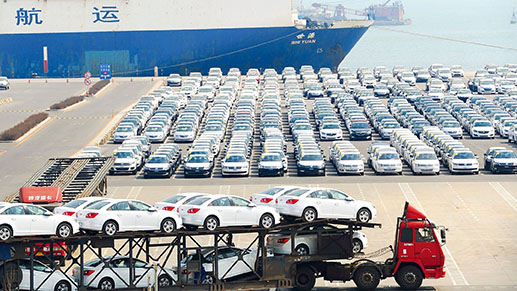
Lorries transporting new cars to the cargo terminal in Dalian, Liaoning Province
Sharing Achievements Emphasized in Proposal
By Zhang Yan
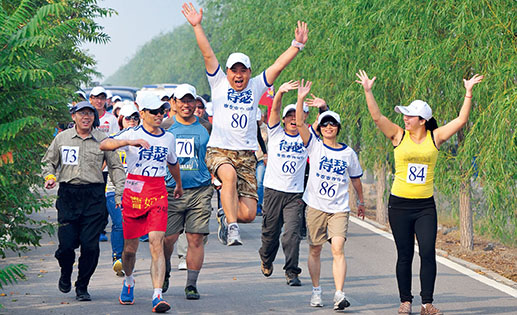
Achievements of development to be shared by the people
The Proposal of the CPC Central Committee for the 13th Five-Year Plan for economic and social development (2016-2020) – hereinafter referred to as “the Proposal” – clearly stated: “We should uphold the principle of development for the people, by the people and sharing achievements with the people; make more effective institutional arrangements so as to enable the people to have a larger share, strengthen the momentum of development and build the unity of the people to make progress towards common prosperity.”
Among the five major development principles of the Proposal, “sharing” is the final goal, an important starting point and vital foothold for progress. “Sharing” should give expression to the improvement of people's level of happiness as well as efforts to maintain their feelings of prosperity.
National Development Principle
The major highlight concerning people's livelihood in the Proposal is to include sharing as a development principle that must be carried out in the next five years.
Gu Shengzu, a member of the Standing Committee of the National People's Congress (NPC) and Vice-Chairman of NPC Financial and Economic Committee, stated: “Sharing development outcomes closely correlates with the goal of building a well-off society. One important idea proposed 30 years ago is to allow some people to get better off first. Now, these people are supposed to help those initially left behind to achieve common prosperity. To reach the goal through sharing is the distillation of the development principle.”
Zheng Gongcheng, a member of the NPC Standing Committee and President of the China Association of Social Security, believes the idea of sharing development outcomes marks a development stage, shifting the goal from encouraging some people to become well-off first to achieving common prosperity.
For a long time, China made progress in its economic development and urbanization, while faced with many emerging issues. The imbalance of development sharpened many social contradictions, hindering people from prospering together, living a better-off life and sharing the development outcomes fully. Therefore, the improvement of people's livelihoods should grow in step with economic growth. That is also the focus of the Proposal.
“Promoting the idea of sharing development outcomes is a reaction going back to the very beginning to resolve social contradictions and issues caused by the imbalance and gap of development,” Zheng said. “This idea creates a clear way to common prosperity and shows the direction to related institutional arrangements.”
No One Should Be Left Behind
“Sharing development outcomes with all” creates the basic standard and necessary road to achieving a moderately prosperous society. Sharing with everyone meets the requirements of justice, fairness and equality. To achieve this, the Proposal set new goals for the building of a moderately prosperous society in all aspects concerning people's livelihood, i.e., to comprehensively improve people's living standards and quality, lift poor people in rural areas out of poverty based on the current national standard, cast off the label of poverty hanging over on all poverty-stricken counties and solving regional poverty issues.
Yang Weimin, Deputy-Director of the Office of the Central Leading Group on Financial and Economic Affairs, views eradication of poverty as key to China's future development.
“To overcome poverty in an all-round way is one of the highlights of the Proposal, and the toughest part of the assigned tasks,” Yang said. “China should eliminate the poverty of more than 70 million people and extricate 592 poverty-stricken counties from their current backward condition in the next five years”.
He also stressed that a comprehensive, moderately prosperous society should embrace all the Chinese people, rather than some. China has already reached the level of a middle-income country, but many issues have emerged, such as imbalance, lack of coordinated development, an unsustainable development model and a wide income gap.
“We have to resolutely fight the fierce battle of removing poverty in the 13th Five-Year Plan,” Yang added.
After 30 years of reform and opening-up, China has lifted more than 600 million people out of poverty, becoming the first developing country to achieve poverty reduction set by the UN Millennium Development Goals. However, as a country with a large territory, China faces issues such as a development gap among different regions and different groups.
According to Zhang Liqun, research fellow of the Department of Macroeconomic Research of the Development Research Center of the State Council, people should achieve a moderately high standard of living regardless of location.
“Sharing development outcomes is the starting point of the 13th Five-Year Plan,” Zhang said. “It is the major feature of the development goals set for the next five years, namely, to build a moderately prosperous society involving everyone; no one should be left behind.”
Zhang also pointed out that the 13th Five-Year Plan focuses on the comprehensive improvement of people's living standards and quality rather than simple growth of income. That embodies the concept of sharing development outcomes.
“To realize the goal of sharing development outcomes, we need to remove poverty; furthermore, we should strive for wider job opportunities, better education and more stable social security,” Zhang said. “Our final goal is to include everyone in the construction of a better future. With sharing, we can see the powerful drive for development and its final goal to realize the constant improvement of people's welfare, which includes remarkable improvement of living standards of different income groups at various levels.”
Meeting Common Aspirations of the People
“Our people look forward to better education, more stable jobs, more satisfied income, more reliable social security, higher level of medical service, more comfortable living condition and a better environment,” President Xi Jinping said. “They also expect their children to enjoy healthier growth, gain a better job and live a better life.”
For President Xi, improving people's well-being and promoting all-round development is the purpose and mission of Communist Party of China, and the core of the 13th Five-Year Plan.
Eradicating poverty in all poor counties, making senior secondary education nearly universal, providing coordinated universal basic pensions for workers, deepening reform of the medical and health system and implementing the policy of “one couple, two kids” are ideas that comply with the common aspirations of the people, whose expectations are only rising.
Yang Yiyong, director of the Institute of Social Development, National Development and Reform Commission, observed: “During the 12th Five-Year Plan, much attention was paid to people's livelihood, and the government made great public investment and extended the benefit to more people. However, the public didn't feel they got the expected benefits due to the immaturity or absence of some systems. Hence, in the next five years, China will increase the supply of public services and improve the capacity for jointly building and sharing them, which means enhancing compulsory education, employment services, social security, basic medical and health care, public culture and environmental protection nationwide. We have to try our best to mobilize social and market resources through various measures to strengthen the material base for sharing development. These measures will make substantial improvement on the effectiveness of the sharing concept meeting the expectations of everyone.”
China in 2011-2015
The 12th Five-Year Plan – which ran from 2011 to 2015 – saw the Chinese economy develop as well as modernize.
The service economy and high tech sectors were particularly strong as China continues to grow
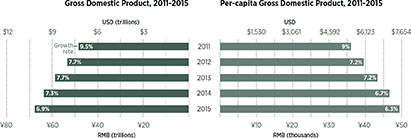
Gross Domestic Product
A key goal of the 12th Five-Year Plan was to introduce more “quality growth” and place less focus on GDP growth alone. Growth averaged more than 7.8 percent from 2011-2015
Service sector importance grows
The service sector has become an integral part of China's economy

Transportation
By the end of 2015, highway networks reached a total of more than 123,000 km while high speed rail links were lengthened significantly, to 19,000 km. China has grown to be the world's leader in high-speed rail technology
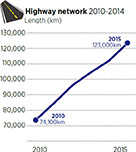
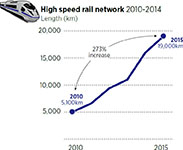
During the 12th Five-Year Plan, major construction work was completed on the Beijing–Guangzhou high speed rail service.
The 2,088km journey now takes only eight hours to complete
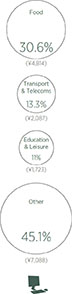
Per-capita consumption expenditure reaches new high
Chinese citizens' consumption spending averaged ¥15,712 ($2,399) in 2015. Here's how those expenses break down
E-commerce sales reached ¥16.39 trillion ($2.58 trillion) in 2014
Urbanization & employment
Trends of urbanization continued, while the labor force grew. Public services – particularly those related to health, transportation and education – received large boosts in funding
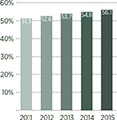
China's urban population (%)
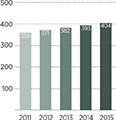
Urban employment (millions)
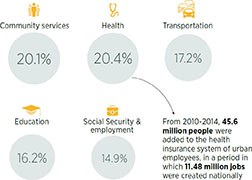
Spending increases on public services 2010-2014
Technology
Mobile phone usage and internet penetration rates shot up during the period of 2011-2015
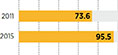
Mobile phones per 100 people
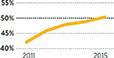
Internet penetration rate
Figures on Gross National Income (GNI) also reflected trends of increased prosperity. According to figures published by the World Bank, China's GNI per-capita grew from $4,300 to $7,380 between 2010 and 2014, an increase of 71.2 percent