

 Copy Reference
Covering a sixth of China’s land area, Xinjiang Uygur Autonomous Region is the largest provincial region in the country. A flight from Beijing to Urumqi, the capital of Xinjiang, takes four hours. Urumqi is further from the ocean than any other city in the world.
A legendary, remote land in northwestern China, Xinjiang served as an important hub along the ancient Silk Road connecting the East and West. Multiple ethnic groups live and prosper in the region which is divided by the Tianshan Mountains into northern and southern parts, and have nurtured Xinjiang into a land of diversity and inclusiveness.
To get a taste of the real Xinjiang, China Report ASEAN made the trip to Xinjiang to interview a group of people of varied ethnicity, age, and occupation. Some are natives who witnessed the dramatic changes in their hometowns, while others were attracted to the place to pursue their dreams. This issue presents snapshots of ordinary but meaningful life in the frontier region.

Young men at a horse racing event in Ili, Xinjiang. (YU XIANGJUN)
A CHANGING EXCHANGE
Abudule Ulasyhale gained a new look on life after frontline experience fighting COVID-19 in Wuhan
By Wang Fengjuan
At 10 a.m. on September 11, Ulasyhale Ulasyhale was making his usual rounds at the Bortala Mongolian Autonomous Prefecture People’s Hospital (BMAPPH). As a doctor in the Intensive Care Unit (ICU), he treats all kinds of acute and severe illnesses and injuries. “Working as an ICU doctor means daily life-or-death fights,” he said. “Every day, I leave exhausted but extremely fulfilled!” Even a surgical mask couldn’t hide his wide grin.
After fighting coronavirus in Wuhan, 33-year-old Ulasyhale, from the Kazak ethnic group, returned to the BMAPPH in July. He went back to work in his department after a short period of isolation.
The BMAPPH is located in Bortala Mongolian Autonomous Prefecture in northern Xinjiang Uygur Autonomous Region. Under the national program for providing paired assistance to Xinjiang, all major medical institutions in Hubei began to offer in-depth and targeted assistance to BMAPPH in 2011. In August that year, BMAPPH gained the title of Bortala Branch of Union Hospital affiliated to Tongji Medical College of Huazhong University of Science and Technology. Teams of experienced doctors started visiting Bortala to help guide the work while young doctors from Bortala gained experience by working at hospitals in Hubei.
Sharpened Skills
Ulasyhale radiates gratitude to medical experts from Hubei. From 2015 to September 2020, four veteran doctors from Hubei were working in the ICU of BMAPPH. They aided treatment and organized discussion of difficult cases, blood circulation competitions, and large-scale free diagnosis activities.
Inspiration from the Hubei medical experts has made Ulasyhale more enthusiastic about expanding his professional knowledge. He now even spends off-duty hours discussing treatment plans with the experts. “Every time I participate in treating a critically ill patient with experts, I learn something new,” he revealed. “For example, no one in Bortala knew about the step-up minimally invasive treatment for severe acute pancreatitis until I saw them do it.”
“We have to become solid professionals to satisfy the Hubei medical experts,” he said, reporting that they learned not only medical knowledge, but also professional ethics. “I have to be like a sponge and absorb the fresh energy the experts bring every day. My colleagues and I must strive to evolve into a high-caliber medical team as expected by the Wuhan experts. This is a big deal for the people of Bortala.”
“The professionalism of the experts moved me,” he added. “I can give you an example: I was once treating a critically ill patient with shock caused by abdominal sepsis at 2 a.m. He could not maintain circulation and had poor respiratory oxygenation. Intubation, ventilator, and resuscitation treatment were required. The patient was in a critical condition. I called expert Xiang Hui. He immediately rushed from the dormitory to the operating room and rescued the patient while explaining every procedure for me.” After stabilizing that patient, Xiang and Ulasyhale treated other patients until dawn. Xiang never returned to the dormitory to sleep.
Xiang Hui normally works as an attending physician in the ICU of Zhongnan Hospital of Wuhan University (ZHWU). In August 2018, Xiang agreed to serve a term in the Emergency and ICU of BMAPPH. Ulasyhale was enthusiastic about learning techniques to treat critically ill patients from experts and watched them make ward rounds closely.
“I was able to intern in Wuhan thanks to a reference from Director Xiang Hui,” Ulasyhale said. In mid-August 2019, Ulasyhale arrived at ZHWU as part of an exchange program between Bortala and Hubei Province.
Doctors’ Mission
After half a year studying in Wuhan, Ulasyhale was ready to take home expanded medical knowledge and honed first aid skills. “ZHWU has many technologies and equipment we could never access in Bortala,” he said. “Learning how things work there will help me devise effective solutions for my home hospital.” Ulasyhale remarked that his mentors in Wuhan provided a wealth of learning opportunities.
Ulasyhale was supposed to complete his internship in Wuhan and return to Bortala before Chinese New Year in January. But when COVID-19 broke out, he immediately talked to the department head and asked to stay in Wuhan.
ZHWU was one of the first hospitals to admit COVID-19 patients. After learning about the shortage of frontline medical workers in pandemic prevention and control at ZHWU, Ulasyhale petitioned the department head to join the ICU medical team of the hospital.
“Medical experts from Wuhan had reached out helping hands to us for so many years. I was thankful I was able to help Wuhan at such a critical moment.” Ulasyhale called it part of a doctor’s duty.
“Wearing five kilograms of personal protective equipment for hours was uncomfortable,” Ulasyhale admitted. “It was also very difficult to speak and write. I was soaked in sweat all day.” It became routine for Ulasyhale to work a 10-hour shift treating COVID-19 patients without eating, drinking, or using the restroom.
“The work was exhausting, but discharging recovered patients motivated me to keep going,” Ulasyhale said. As a frontline medical worker, he stayed on-call around the clock.
The department where Ulasyhale worked admitted a total of more than 100 critically ill patients, and many recovered. More than 50 patients’ conditions improved enough to transfer them out of the ICU ward.
“We were racing the clock, so we couldn’t avoid regrets.” Ulasyhale gravely described a pregnant woman in her 30s being admitted to the ICU with typical COVID-19 symptoms who didn’t make it. “Although I was very upset, I had to stop myself from giving up because many patients were still depending on treatment.”
As he was treating patients in Wuhan, Ulasyhale’s 3-year-old child was admitted to the hospital back home thousands of miles away. To keep him focused on his work, Ulasyhale’s parents promised to help his wife. “After getting off work, I always called home right away to ask about my child’s condition,” Ulasyhale recalled, his voice choking. When he heard the recovered child ask over the phone, “Where are you, Dad? Why don’t you come home?” he almost cried.
Now back at BMAPPH to continue treating critically ill patients, Ulasyhale often shares his experience as a frontline medical worker in Wuhan with his colleagues.
“Although we have avoided the pandemic in Bortala, prevention and control efforts should not be relaxed,” Ulasyhale said firmly. “Wherever they are, those in white uniforms should stay ahead of the virus.”

Abudule Ulasyhale.(WANG FENGJUAN)

Abudule Ulasyhale at work in the ICU of Bortala Mongolian Autonomous Prefecture People’s Hospital. (YUSUUPU AINY)
HEART OF GOLD
Wang Guizhen reaches out to people in need year after year
By Xu Hao
The garden was green with ballooning vegetables. The stack of firewood was teetering tall. The aroma of steamed stuffed buns wafted through the window. The snow blocking the door was totally cleared away.
As summer gave way to autumn, the begonias in the yard bloomed again with yet another change of season. At 80, Wang Guizhen’s steps are not quite as vigorous as they once were. She doesn’t wield as much energy and strength as she once did. But one thing has never changed: She still loves to reach out to people who need help and improve their situation, as she has for decades.
Born in 1940, Wang is the mother of seven. Many women in her generation had similar experiences. Wang raised her children while tackling all the household chores. Yet she was always doing warm little things to help other people year after year, and her extraordinary behavior affected people across the city.
Local Uygur people call her “Atonham,” which means “a heart of gold” in Uygur language.
Helping Hands
Hutubi Century Park Scenic Area is in the center of Hutubi County in the Changji Hui Autonomous Prefecture of Xinjiang Uygur Autonomous Region. Before construction began in 2004, the area had shanties inhabited by various ethnic groups. Wang Guizhen used to live there.
Wang and single mother Nyatsiham were neighbors. Nyatsiham’s children left home when they grew up, leaving her alone and too old and sick to work. Wang went to the lady’s house almost every day to help her clean up, wash and dry the bedding, buy groceries, and grow vegetables. “Thank you for taking care of me,” Nyatsiham said to Wang. “I have been ill for so many years, and even my relatives did not take care of me as well as you have. You are truly my Atonham.”
Soon, Wang’s Uygur name “Atonham” became more and more well known.
More than half of the residents in her community are Uygur people. Wang has been helping 16 people for a long time, among whom 12 are Uygurs. Seven seniors she used to care for have passed away. Yet, Wang’s own family burden was also heavy. She was laid-off from a job, and her husband’s salary was not high. Her in-laws became successively bedridden, and she is the mother of seven.
But Wang considers it human nature to help neighbors and families in need. “I have to reach out when I realize others have difficulties,” Wang said. She lives frugally. When she was young, Wang would sew torn clothing so she could continue wearing it for many years. She would walk to save bus fare. In her spare time, she would do odd jobs and pick up salvageable items from trash piles. The money she earned was used to help others. She only stopped rummaging through trash heaps a few years ago when her age caught up with her.
Henysa Mokhan, who has been Wang’s neighbor for 30 years, said that elderly Uygur neighbors sitting outside in the sun would put their hands on their chest when seeing Wang approach.
Influencer
“Didn’t I support you from the start?” once asked Wang’s husband Chen Haode. “But you have been supporting others for so many years.”
“Why do you get so excited tackling other people’s problems?” asked her daughter. “You don’t have much money, but you are always enthusiastic about helping others.”
But gradually, they all grew to understand Wang and find inspiration in her work. Wang’s eldest son works in Karamay City. Every time he comes home to visit, he takes his mother to the market to buy groceries and then drives her to the people waiting on her help. This has become the standard routine.
“Reaching out to people who need help makes me feel good and sleep sound,” Wang Guizhen said.
Over the years, so many people have been influenced by Wang and followed her footsteps. After receiving aid from Wang, Henysa has been paying back the kindness to others for more than 10 years.
“I was so moved by Wang that I had to follow her example,” Henysa said.
Chen Jiang was also inspired by Wang Guizhen. Chen is nearly blind, and her husband did most of the work for the family. But in 2010, Chen’s husband became bedridden with illness. As Chen was feeling most hopeless, Wang walked into her life. Wang often brought vegetables and meat to Chen’s home and took care of the whole family, which helped Chen regain confidence. In 2014, Chen’s husband was finally able to go out on his own to receive rehabilitation treatment. Since then, Chen has emulated Wang’s example to bring warmth to others.
“Ethnic solidarity is great!” exclaimed Henysa. “Just like Aunt Wang did to neighbors, the fact that people of different ethnicities live in harmony is true solidarity! No Uygur here is called ‘Atonham,’ because the precious name has been dedicated to her.”
Led by Wang Guizhen, a volunteer team was formed, including Henysa, Chen Jiang, and Li Yang, and has been expanding over time.
Ethnic Solidarity
From 2012 to 2013, Wang Guizhen led the people of various ethnic groups in her community to spontaneously organize the “Atonham” Volunteer Team and “Atonham” Mutual Aid Fund. Many from the Han, Uygur, Kazak, Hui and other ethnic groups have been inspired to participate.
In 2014, Hutubi County established the “Atonham” Volunteer Service Corps, which now features 168 affiliated squads. More than 26,000 people have registered as volunteers.
Since 2015, the 30th day of each month has been named “Public Welfare Day” in Hutubi County, and on that day volunteers participate in various activities. In 2016, Shuangqiao Community, where Wang Guizhen lives, was renamed Atonham Community.
“Atonham” has become known throughout Hutubi County. Wang Guizhen never expected her simple kindness to exert such a massive impact on society.
One person can make a big difference.

Local Uygur people dubbed Wang Guizhen “Atonham,” which means “heart of gold” in Uygur language. (XU HAO)

Wang Guizhen (center) with two volunteers on September 12, 2020. The volunteer service corps has attracted more than 26,000 registered volunteers from various ethnic groups. (XU HAO)
ACCORD ALONG THE RIVER
Rich cultural legacy of accordionists in China’s Xinjiang Uygur Autonomous Region
It’s hard to guess what might be waiting around the corner of streets along the Ili River in northwest China’s Xinjiang Uygur Autonomous Region.
Liuxing Block is unlike any traditional neighborhood. The streets radiate from a central axis, dividing the block into six neatly arranged fan-shaped regions. From European-style attics with slanted roofs to Russian-style porticos, Kazak tapestry, Uygur wooden and stone carvings, and a variety of ironwork decorations, the block is a treasure trove of architecture and ethnic folk arts as well as a hotbed of gourmet delicacies from several Chinese ethnic groups.
The multi-ethnic block is located in northwestern part of Yining, capital of Ili Kazakh Autonomous Prefecture in Xinjiang. Designed by a German architect, it was first built in 1930 and has evolved into a cultural destination.
Accordion Appeal
The breezy melody of the Russian folk song Katyusha was wafting from Alexander’s accordion museum, luring passersby to the second floor. There, rows of accordions of different sizes and colors wait to greet visitors. On this day, an ensemble was playing live music.
Alexander, leader of the ensemble, was dressed in a white laced tunic, red trousers, and black leather boots, a typical outfit for an ethnic Russian in China. His face beamed as he played.
“Every accordion here works except for the models,” said Alexander, owner of the museum. He has spent over 40 years collecting the musical instrument, and has amassed more than 1,000 accordions from over 20 countries. Among them are an antique produced in 1872, a palm-sized accordion, and a foot-blown unit weighing 16 kilograms. He bought it from Australia for 20,000 yuan.
“Yining is the capital of accordions to some extent,” continued Alexander. “Playing the accordion is how ethnic Russians living here express happiness and sorrow.” Born in 1958, he grew up by the Ili River and can speak Russian, Uygur, Kazak and Xibe languages. His passion for accordion started early.
Son of an accordionist, Alexander grew up with the music. His father played accordion and sang with neighbors in the yard. When the music rang out, people would dance merrily. In years past, the accordion was a luxury. Alexander could only touch one when his father and three elder brothers weren’t playing. “I made a decision to master the art,” Alexander recalled. At the age of 10, he became an apprentice to his father and learned how to play and maintain accordions. Now, he is a master. He knows how to construct bellows, reeds and other parts of the instrument as well as how to tune it.
When Alexander was 15, he learned that a friend of his father had a spare accordion for sale. He fished the Ili River every day to save up money. Across a whole summer, his back became tanned and hands covered with calluses. The effort was worth it. He saved 300 yuan and borrowed the other 50 to buy the accordion. Ecstatic, he ran home with the accordion in his arms and couldn’t wait to play it.
Despite the meager income he earns maintaining accordions, Alexander continues devoting his efforts to the accordion collection out of passion for the instrument. Many of the items are expensive antiques.
According Friendship
“Alexander is not good at accordion repairs, he just collects all the ones that work,” some have joked. “They trust me,” Alexander rebutted. “They know I’m the best person to set things right.”
“When the music starts, dance follows, and strangers become close,” Alexander said.
In 2002, Alexander represented Ili and played Danube Waves with renowned Chinese accordionist Zhang Zhiqiang in Urumqi, capital of Xinjiang. The performance inspired thunderous applause from over 1,000 spectators. Encouraged by Alexander’s success, many accordion enthusiasts in Liuxing Block began to gather to play.
In March 2019, Alexander formed an ensemble composed of retired teachers, folk artists, police officers, and volunteers. Members hail from different ethnic groups including Kazak, Hui, Xibe, Uygur, Russian, Tatar, and Kyrgyz.
“We gather to share our passion,” exclaimed Hezatola Aniwar, a Tatar member of the ensemble. “The accordion is how we build happiness and friendship.” He was a teacher and translator of ethnic languages before retirement. Guo Shunming, from the Xibe ethnic group, has been a friend of Aniwar for 30 years. He joined the ensemble upon an invitation from Aniwar.
More and more music enthusiasts followed suit. Xiuna, from Mongolian ethnic group, glowed in a red ethnic dress. “We soak up the music streaming from the accordion,” she grinned. “We practice, chat, and enjoy life together.”
The ensemble’s repertoire includes popular Russian songs such as Katyusha and Kalinka as well as Kazak and Tatar dance music, showcasing the cultural diversity of Ili.
‘We Made It.’
May 14, 2019 was an unforgettable day for Alexander’s accordion ensemble. That day, they played distinctive Ili music in Beijing for a nationwide audience.
“I was nervous and excited, but as soon as we reached the stage, accordions were all that mattered,” Alexander recalled. The performance was a great success. As the applause reverberated, the ensemble members hugged each other in excitement. “It was incredible. We made it!” they exclaimed.
Following that performance, they received a steady stream of invitations to perform across the country.
“Every one of us represents an ethnic culture,” explained ensemble member Hezatola Aniwar. “When we perform together, the artistic charm is irresistible. Everyone loves it.”
Despite a lack of formal musical education, Alexander is talented. He has been composing original tunes inspired by everyday life for a long time. When he was young, people living in his neighborhood had to fetch water from a well. Young boys and girls realized the chore provided a perfect chance for dancing and romance. Such sweet memories are featured in Alexander’s dance music. He also sings out his affection for the Ili River.
The ethnic Russian accordion is under provincial-level protection in Xinjiang as cultural heritage. In August 2013, Alexander became an inheritor of the heritage. “We live in exciting times,” he proclaimed. “The state values our traditional ethnic culture. I am honored to guard it and carry it forward.”

Alexander plays an accordion. (GU XIAOXIA)
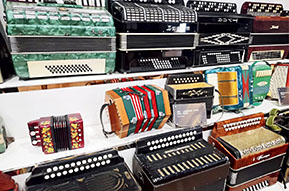
Accordions of different sizes and colors in Alexander’s collection. (WANG FENGJUAN)
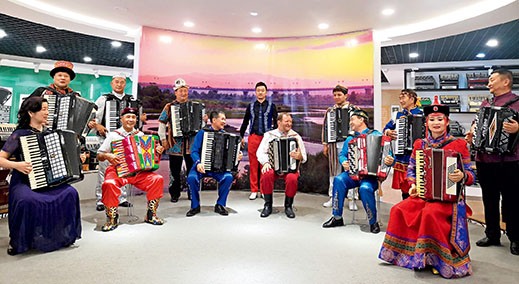
Alexander and his ensemble present a live performance at the accordion museum. (WANG FENGJUAN)
TAILORING A BETTER LIFE
Sewing machines have changed the lives of 3,000 in the Xinjiang Uygur Autonomous Region
By Wang Fengjuan
“I’m just doing what I can to help the people in my village and neighboring communities,” said Gu Xumei, founder and manager of the May Xumei Garment Company in Tuoqiyuzi Village, Yining County of Ili Kazak Autonomous Prefecture in Xinjiang Uygur Autonomous Region.
“There’s much more to do,” she added. She was wearing a neat suit she sewed herself and tied up her hair like a next-door neighbor.
For nearly 40 years, Gu has been working hard with sewing machines. Extensive exposure to UV-intensive sunshine over the years has left her skin tanned.
She has traveled extensively to assist more than 3,000 local poverty-stricken women seeking to rise from poverty to prosperity. Her contributions and company are well known and respected locally.
Following Mother’s Footsteps
Nearly every inhabitant of Tuoqiyuzi village is from an ethnic minority group. Gu migrated to the village with her parents as a very young child. At first, things were difficult for her family, which dwelt in a small two-room house rented from a Uygur neighbor. She grew up alongside the children of her neighbors. When she was hungry, she could always find some food, either milk tea or naan (baked bread), from her neighbors. She recalled that one day when she was very hungry, a playmate generously offered her half of his naan. She remembered her neighbor’s kindness to this day.
Gu’s mother was a skilled tailor. When her neighbors needed clothes but lacked the money to pay a tailor, her mother offered to do it for free. When someone wanted to learn the skills, she offered to teach patiently. When Gu was young, she often watched her mother make clothes for neighbors in dim light. “My mom had often said that helping others is helping yourself,” said Gu. She grew up in quite a loving atmosphere.
In 1982, Gu Xumei graduated from high school and began to study her mother’s skills harder. To become even more professional, she bought some books on tailoring. She devoted most of her time to learning and practicing the skills. When she took a break from working in the field, she would draw on sketches she had just learned from the books in the dirt. When she discovered that a master tailor from Shanghai was working at the township bazaar, she immediately went to see her to learn more.
After three years of learning and practice, Gu became so skilled at tailoring that she made her own wedding dress. In the spring of 1985, she showed up at her wedding ceremony in a red Chinese dress that she constructed herself. The guests marveled at her elegance and skill.
After she married, Gu opened a tailor shop. Soon, she earned a sterling reputation for her fine tailoring at a fair price. More and more customers visited her shop for new dresses. Other villagers expressed interest in learning from her. Gu didn’t hesitate to teach apprentices for free. She has now been doing it for over 30 years.
“I reached out to some disabled women and women in poverty-stricken families,” said Gu. “I hoped the skills would enable them to make a living for themselves and their families.”
“My mom didn’t charge her apprentices for the skills,” Gu stated plainly. “I did what my mom did.”
Assistance for Her Apprentices
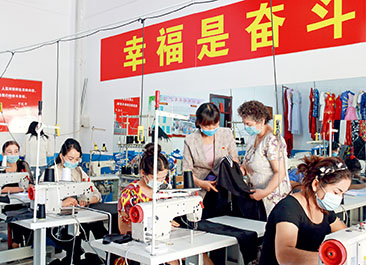
In the workshop on the second floor of her company’s building, uniformed employees were busy preparing an order of school uniforms. More than 50 electric sewing machines clicked in rhythm. It was their first order of school uniforms since the second wave of COVID-19 infections occurred in Xinjiang.
Shabbiremu Ahmat hailed from a registered poverty-stricken farming family of five. She is now a skilled tailor after starting apprenticing with Gu’s company in 2016.
“My monthly income is now more than 2,000 yuan (US$310),” she reported. “This job is so close to home that I can work and raise my kids. It has helped lift my family out of poverty.”
“Without orders, my apprentices can’t make money,” admitted Gu. So, she has traveled a lot over the years to establish relationships with markets, schools, hospitals, and garment factories in the area. She even traveled to the autonomous region’s capital Urumqi to that end.
“The first few years were tough,” she recalled. “When I returned home after a long winter journey, my feet were frozen numb. It would take quite a while to revive them in hot water. I didn’t care much about my apparel then. I wore a white windbreaker, a gift from my cousin, for three years straight. Eventually, I started wearing clothes I made myself to ensure my skills were on display.”
Gu is satisfied with her achievements over the 30 years. “I’m happy to see so many apprentices doing well.”
Asiguri Tursun has a disabled leg. She became Gu’s apprentice at the age of 16. Gu and her husband Ding Shengli took care of her for 10 years until she married. Now in her 30s, Tursun works at home on an electric machine Gu gave her, while raising her children.
Kaminur Yerdi is another apprentice living in Gongyue Community in Yining County. With Gu’s support, Yerdi opened a tailor’s shop in her community, where she makes clothes for locals as well as market stalls.
“When I first opened the shop, my skills were still not that great,” admitted Yerdi. “Some of the clothes I made failed quality control. This is when Master Gu offered me assistance.”
Word of Gu’s deeds spread far and wide, and more and more people from neighboring villages and towns, as well as other regions in southern Xinjiang including Kashgar and Hotan, sought her out. Over the last 30 years, Gu has trained more than 3,000 apprentices from different ethnic groups and provided them follow-up support to start their own businesses.
Passion for Public Welfare
Ganarguri Gemazan (Kazak) was Gu’s apprentice 20 years ago. She and her husband used to both work part-time jobs to get by. Gu taught her the skills and donated equipment for her to start a business.
“My family used to be very poor and had little land or money,” Gemazan said. “Master Gu offered to help me rent space near my home to open a tailor’s shop. She also provided equipment including a sewing machine.” When Gu handed her the keys to the shop, Gemazan’s eyes welled up. She embraced Master Gu tightly for a long time.
Recalling the generosity brought a lump to her throat. Today, Gemazan’s life is totally different. She built a new house for her family. Following Gu’s example, she is also training tailors for free.
“My philosophy has always been that helping one person can change a whole family, and from there, the changes can radiate and gradually change our hometown,” said Gu. This simple notion drove her to help thousands.
This year, the coronavirus outbreak has had a big impact on the tailoring business, like so many others. “When I started receiving orders from regular customers again, I immediately distributed them among my apprentices,” said Gu. “Stable jobs stabilize our families.”
Alongside the free skills training, Gu helps her apprentices solve other problems in daily life. When they fall ill, she helps them see the doctor. When they need a machine, she provides one. When they suffer injustice, she fights on their behalf.
But to do all this, Gu often had to ask her own family to wait.
“At first, I couldn’t quite understand why she was so preoccupied with her apprentices every day,” sighed her husband Ding Shengli. “It always felt like her apprentices came first. I ended up raising our children more. When our younger daughter pleaded for a bicycle, she was busy buying sewing machines for her apprentices. Neither daughter ever used a bicycle bought by their mother. But now that they’re grown, our daughters profoundly understand what their mother does and have followed her into public welfare, such as taking care of elderly people who live alone.”
“Over the years, Xumei’s deeds have been recognized by the local government,” added Ding. “She has even won some cash prizes. But she never took the money home. Instead, she bought things for people who really need them.”
“That’s my wife!” exclaimed Ding with pride.

Gu Xumei, who has helped 3,000 people escape poverty through tailoring. (WANG FENGJUAN)
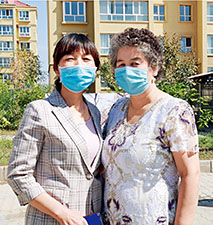
Gu Xumei (left) poses with apprentice Kaminur Yerdi. (WANG FENGJUAN)
Gu Xumei shares experience with tailors at apprentice Kaminur Yerdi’s shop. (WANG FENGJUAN)
NEXT-GEN FARMERS:
Livestreaming Turpan fruits
By Xu Hao
The first time I saw Abedola Umuer, he was wearing a bright green T-shirt that seemed to darken his skin and a smile as bright as the Turpan sunshine. Located in eastern Xinjiang Uygur Autonomous Region, Turpan has an extremely continental desert climate featuring long and intense sunshine in the summer. Born into a farming family, the young man often works in the field in such sunlight all day long.
But he is not only a farmer. “Which pear fans at home can tell the difference between so-called male pears and female pears?” he asked to his online viewers. “First person to give me the right answer gets a free box of pears.” Umuer is comfortable on camera as a seasoned livestream salesman.
Umuer adopted the screen name Oubai Farmer Second Generation, which he believes is particularly suitable since he is a son of farmers. The 25-year-old is founder of Turpan Oubai E-commerce Co., Ltd., a locally renowned entrepreneur and an online influencer with a strong following on livestream platforms.
Since COVID-19 broke out at the beginning of this year, Umuer has been helping local farmers sell Turpan produce including fresh grapes and raisins on livestream platforms. His team’s sales have reached 8 million yuan (US$1.2 million).
Business Back Home
Turpan City lies on an oval-shaped intermountain basin. The world’s second lowest place after the Dead Sea, Turpan was once an important town on the ancient Silk Road. Its unique climate makes local fruits popular, and its output of grapes accounts for a fifth of the nation’s total. For many, Turpan is synonymous with sweet grapes.
In 2015, Umuer graduated from Xinjiang Vocational and Technical College of Construction and began working with an e-commerce company in Changsha, Hunan Province. Living 3,500 kilometers away from his hometown, Umuer discovered that the grapes he knew as affordable and common in Xinjiang sold for much more in China’s inland areas.
“I realized that selling my hometown grapes to the inland markets would be worth a lot of money,” Dula said. “Turpan farmers could earn more money, and people in the inland cities would get more quality grapes.”
To learn business management, Umuer spent his spare time visiting the headquarters of Alibaba Group in Hangzhou, Zhejiang Province, and auditing classes at Peking University and Zhejiang University. The longer he was away from his hometown, the more he yearned to return to start a business. He dreamed of enabling his parents to learn more about “the world out there” by bringing back things that they might consider novel.
“I continued studying and working in e-commerce until I was confident in my skills,” Umuer said. “When I heard the Xinjiang government was promoting development of tourism, I finally decided to come back.” In 2017, he returned to Turpan and co-founded Oubai E-commerce Co., Ltd. with his friends.
They rented a house on a commercial street in Putao (Grape) Town of Gaochang District, Turpan, and started selling fresh grapes, Hami melons, dried fruits and nuts, and local souvenirs. He also started offering services like collecting deliveries for customers, shopping online for local farmers, and providing e-commerce consultation and training.
By cooperating with supply chain companies in inland areas and with sellers on Taobao, a Chinese online shopping platform, Umuer’s company grew fast. In 2019, Oubai E-commerce sales exceeded 10 million yuan (US$1.5 million).
Livestreaming
Umuer’s company is situated in a two-story building. The structure looks basic on the outside but is quite dazzling inside. The first floor features a hall with Uygur characteristics that exhibits and sells foods such as raisins, goji berries, and honey products, and souvenirs including tapestries and carpets. The office area and livestream rooms are on the second floor.
We have launched channels on a variety of online shopping platforms including Pinduoduo, Taobao, Douyin and Kuaishou. “Every March we begin selling in-season fruits online starting from tomatoes to apricots, Hami melons, grapes, prunes, pomegranates, and apples.”
To make e-commerce more user-friendly, Umuer worked with his team to develop an extension for WeChat, and have recruited over 300 marketing agents nationwide.
Oubai E-commerce features an internet-based work model and young staff. The company now employs six livestreamers, of which four are college graduates, and has amassed 850,000 followers across all their selling platforms. Umuer also shoots short videos for his followers. For example, he shared the maturation process of grapes to allow potential buyers to see how grapes are planted and be assured that the grapes they are buying are organic and fresh.
Umuer showed me some of his short videos on Douyin, the Chinese version of TikTok. Because Turpan is a famous tourism attraction known for its historical relics and distinctive ethnic features, he posts videos not only about his products but also about local traditions and characteristics. Such “non-profit” short videos have gained numerous followers.
“We only sell products customers can trust,” Umuer said. “Before each livestream, we visit the farm to check the quality of the produce we are set to sell. The produce must meet the standards of green agricultural products.” He revealed that once, un-checked tomatoes broke en route to the buyer, which solidified his determination to strictly control the quality of each product they sell.
Despite delivery time slowing due to COVID-19, Umuer and his team hardly stopped for a moment. Supported by the government service platform, they developed the Uygur-Han bilingual “Intelligent City Service” system for urban delivery. They coordinated with local greenhouse farmers and breeders to secure a food supply and managed the sorting, disinfecting and delivery of foods. During the outbreak, they delivered 50 tons of living materials.
Greater Expectations
To set a standard for grape planting and improve the fruit’s quality, Umuer and his friends established an agricultural cooperative which attracted two dozen farmers to plant 80 hectares of grapes. At the same time, they opened township delivery stations, shops for Xinjiang products, and multiple online stores and hired 25 local farmers and herders to perform packaging and delivery.
Alongside fresh produce, Oubai E-commerce also sells dried fruits and nuts, and has been engaged in purchasing seeds and fertilizers for local residents.
When Umuer first returned in 2017 to start his own business, his father did not agree with the decision. “It was not easy for him to get out of here, and I really did not understand why he would want to return to rural life.” But the father gradually softened and even became an influencer himself thanks to his son’s intense influence. He has gained thousands of followers on Douyin by posting short videos of grape planting and raisin processing.
Turpan is blessed with abundant sunshine and plentiful underground water. Because the local temperature varies widely from day to night, the sugar content of local fruits is remarkably high. Umuer is proud of his hometown, and he wants to send Turpan’s sweet fruits to more places to help the world discover how marvelous the place is.
This year, Umuer and his team set the goal of annual sales of 15 million yuan (US$2.3 million). “Through livestreaming, we had achieved 8 million yuan in sales by the beginning of September, so this year’s total sales will surely be higher than last year.”
After years of efforts, Umuer is confident he made a right decision to return. “More and more locals are coming to us,” he said. “They are enthusiastic about selling their products to the whole country.”

Abedola Umuer sells produce via livestream in Turpan, Xinjiang Uygur Autonomous Region, on September 12, 2020. (XU HAO)
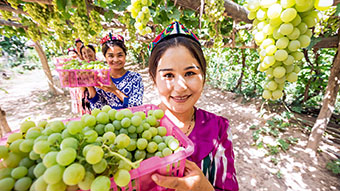
Villagers display grapes in Yaqa Town, Kuqa City, Xinjiang Uygur Autonomous Region, on September 15, 2020. (YUAN HUANHUAN)
YOUNG PROFESSIONALS
Xinjiang youth are working hard to seize their dreams
By Wang Fengjuan
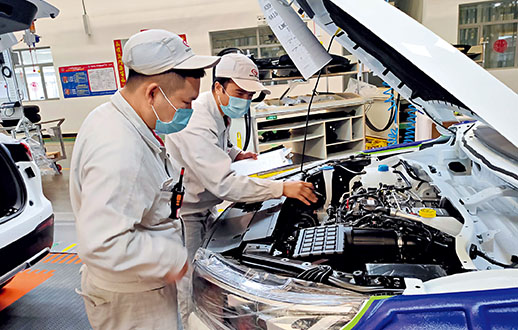
Maiura Abduwak (rear) instructs a colleague on automobile assembly techniques.
Many say that youth is the time to dream. During a recent Xinjiang trip, I met several young people who are working hard to chase their dreams and interviewed two professionals working in automobile manufacturing and environmental protection, respectively.
Growing with the Company
At the Xinjiang assembly plant of GAC Motor in Urumqi Economic and Technological Development Zone, I found Maiura Abduwak instructing colleagues on dos and don’ts. As head of the external assembly team of the Final Assembly Division of the Manufacturing Department, every day he arrives half an hour earlier than the team to review the previous day’s work and make plans.
Abduwak has been working at the plant for three years after graduating from Xi’an Jiaotong University with a master’s degree in machinery engineering. He and his team complete the final steps of assembling an automobile. “When I click the button indicating the completion of our initial setup, an entire automobile is ready for functional examination,” he explained with pride. Last year, his factory produced about 5,000 vehicles and sold 5,840, achieving an output value of 484 million yuan (US$72 million).
Abduwak feels lucky to work at the GAC Motor Xinjiang Branch. “I became fond of tools and machinery as a child,” he recalled. “I often took apart toys and then put the pieces back together, and even graduated to radio and TV sets. When I couldn’t reassemble something, my dad would help me out.” Abduwak was born into a farming family in southern Xinjiang. His parents did their best to support his education and eventually helped him through postgraduate studies in machinery engineering. “Far beyond simply assembly, machinery engineering involves a wide range of knowledge such as computer sciences, programming, and software development,” he said.
While still a student at Xi’an Jiaotong University, Abduwak submitted his cover letter and resume to GAC Motor during an on-campus job fair after learning that the automaker was planning to establish a production base in the first national-level economic and technological development zone in Xinjiang. After graduating in 2017, he landed a job at his “dream factory” and began working under the supervision of Xie Fuqiang, chief of the Final Assembly Division.
“Chief Xie is only a few years older than me but he was then already quite a capable expert, which set a standard for me,” Abduwak recalled with admiration. He first endured an uneasy period before becoming familiar with equipment he had never seen as a student and getting to know how to apply the professional theory he learned on campus to practical work. From site safety and management of plant construction to equipment installation, debugging and acceptance, Abduwak witnessed the completion, quality examination, and official launch of the main body of the production base while at the same time mastering the necessary knowledge and skills. Besides, he has also assisted Chief Xie in organizing assembly skills competitions.
GAC Motors provided Abduwak technical skills and management experience which boosted his prospects in a big way. He bought a 3-bedroom home in Urumqi and moved his wife and child there to go with his car that he personally bolted together. This year, he joined colleagues on a passenger car marketing program and spent holidays giving lectures on auto functionality at GAC Motor 4S (sales, parts, service, surveys) stores. “GAC Motor changed my life, and I’m happy I was able to grow with it.”
For the Environment
Dirshati Aishajong was preparing for a routine meeting when a morning sunbeam crept through the window onto his desk. Head of the Environmental Protection Department of Ili Chuanning Biotechnology Co., Ltd., he arrived in Ili in the midnight after an environmental evaluation meeting in Urumqi, with fatigue on his face.
Ili, a land blessed with pleasant weather and abundant resources, is where Dirshati Aishajong was born and raised. He became enthusiastic about environmental issues as a child and chose the discipline of ecology at college with hopes to use science and technology to protect the blue skies and clear waters of the place he calls home.
After graduating from the Beijing University of Science and Technology in November 2011, he returned to Ili and joined Chuanning’s Environmental Protection Department as its fourth member. At first, he had a hard time adapting to the tough working and living conditions while construction of an office building and residential facilities for the new company was still underway. “Did I do the right thing?” he repeatedly asked himself while also striving to familiarize himself with the new environment and integrate with the corporate culture.
When he felt the lowest, Aishajong finally met the company’s chairman, Liu Gexin. Liu’s open-mindedness, broad vision, and down-to-earth personality deeply impressed Aishajong and gave him the determination to forge ahead with Chuanning. Eventually, Aishajong and more than 60 other staffers were overcoming challenges and tough days together.
In April 2014, the company’s phase 1 production line passed inspection and began operation. In 2015, Aishajong was promoted to deputy director of the Environmental Protection Department. To implement the company’s environmental philosophies, the department introduced state-of-the-art technologies and equipment to manage “three wastes” (gas, water, and residue) to address environmental problems arising in phase 1 construction. They also invited renowned environmental experts to diagnose, strengthen, and optimize existing treatment methods. “I felt proud of my company’s environmental awareness upon seeing the introduction and operation of the waste treatment equipment,” Aishajong said.
As environmental protection concepts were gradually woven into the fabric of the company’s growth, Aishajong worked his way up a career ladder from an entry-level to chief of the Environmental Protection Department, now overseeing as many as 400 staff members. According to him, 30 to 40 percent of department employees are ethnic minorities, and the company ensures everyone the opportunity to explore their potential to the full regardless of age or ethnicity.
Aishajong hails from rural area. In the past, very few villagers in his hometown ever attended college. “Today, all the parents in my hometown value education and believe knowledge leads to a brighter future,” he said. “My wife is a Ph.D., and our daughter will certainly attend higher education.”
Aishajong attributes his personal growth and development to Chuanning’s growth, which has fueled his passion and confidence. “I would have never made it this far without the platform provided by Chuanning,” he said.

Dirshati Aishajong with his family.
PASSING ON A LEGACY
Xinjiang craftsmen are bringing back millennium-old mulberry paper
By Wang Fengjuan
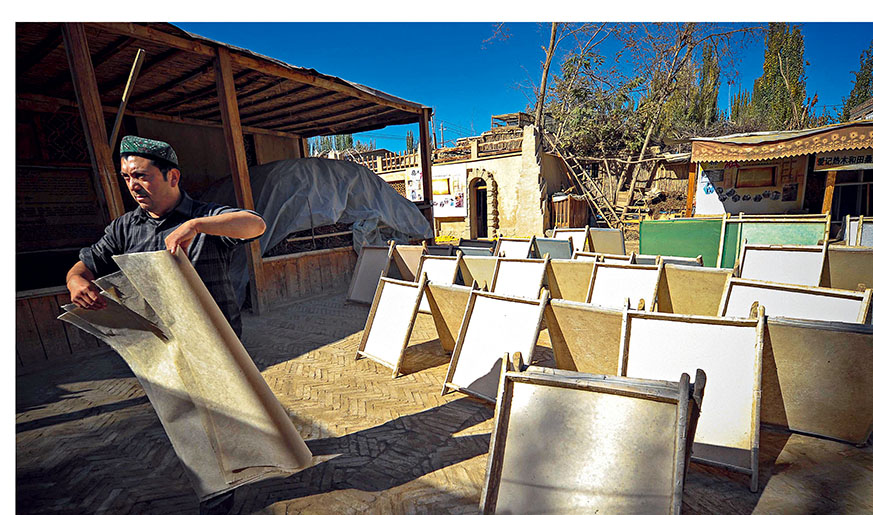
Handmade mulberry paper dried in a courtyard in Buda Village. (LIU XIN)
Yohana Margaretha, a reporter from Indonesia’s Metro TV, was immediately fascinated by the piles of handmade mulberry paper dried in the courtyard after she pushed open the wooden door of the mulberry paper workshop in Karakax County, Hotan Prefecture, Xinjiang Uygur Autonomous Region. The old-fashioned carved wooden windows of the houses and various traditional papermaking tools made the trip feel like time travel to her. It was her first visit to Xinjiang and first experience with its traditional mulberry paper. Driven by curiosity, Margaretha tried making a sheet of mulberry paper herself with the traditional tools.
“Mulberry paper is a traditional handmade paper that has recently gained popularity among scholars and tourists from China and beyond,” said Wei Baoshan, eyes glistening with excitement. He considers the paper, historically called “Hanpi paper,” a living fossil of Chinese papermaking. It is known for strong tensile strength and moisture-resistance, and its color doesn’t fade even after centuries of weathering. The paper is made from bitter mulberry bark and fermented with alkali extracted from Euphrates poplars, which makes it moth resistant. In 2004, experts from the Palace Museum in Beijing sought out mulberry paper from Xinjiang to restore ancient paintings and calligraphic works.
“I spend almost all my days exploring new ways to pass on, protect, and utilize mulberry paper,” said Wei. “I found a new outlook on life when I discovered this traditional paper.” Wei is vice executive president and secretary-general of the Xinjiang Academy of Traditional Chinese Painting. He has been noted for his Hami melon paintings, but today, he is better known as an inheritor of Xinjiang mulberry paper. Wei’s devotion to mulberry paper has continued for many years. Through integrating the handmade paper with traditional Chinese painting, paper cutting, and other artistic and cultural genres, he has managed to inject new vitality into the centuries-old cultural legacy.
An Endless Bond
Wei was first drawn to mulberry paper at a 2011 art exhibition themed “Traditional Chinese Painting on Mulberry Paper.” “I loved how the natural color and texture of mulberry paper gave a vintage flair to paintings, especially those depicting Xinjiang’s wonderful landscapes,” he recalled. “I had never imagined traditional Chinese painting looking so great on mulberry paper.” Wei has maintained his passion for the paper ever since.
To gain a deeper understanding of mulberry paper, Wei visited Buda Village in Purchaqchi Township, Karakax County, which is known as the “home of mulberry paper.”
With help from friends, Wei met up with mulberry paper craftsman. When he arrived at the craftsman’s home, the grey-bearded man in white clothes was skinning mulberry branches on an earthen bed covered with carpet. He agilely peeled off the semi-transparent greenish inner layer of the bark, the most important raw material for mulberry paper, with a small knife. A pile of finished mulberry paper of varied sizes rested on a long, narrow table aside. The old craftsman was Tohti Barker, an inheritor of mulberry paper, who already gets help on simple tasks from his children.
“The technique for making mulberry paper has been passed down from generation to generation in the Barker family for more than 1,000 years, and Tohti Barker was the 10th-generation inheritor,” said Wei. “Because the paper is seldom used these days, Barker could not subsist on the craft alone. He even started shearing his neighbors’ sheep just to make ends meet. Yet he still did not give up this traditional craft.” Tohti Barker’s persistent devotion to mulberry paper moved Wei while also leaving him concerned about the future of the ancient trade.
Wei decided that inheritance and protection of mulberry paper should focus on exploring its profound cultural connotations alongside boosting sales.
In the Qing Dynasty (1644-1911) and the Republic of China period (1912-1949), mulberry paper was widely used for documents, banknotes, textbooks, stationery, and herbal medicine packing in Hotan. This paper was still used for government documents, contracts, and packing as recently as the 1950s, but was gradually replaced by modern mass-produced paper. Many mulberry paper craftsmen shifted to other professions, and this ancient craft teetered on the verge of extinction with only a handful of households in Karakax continuing to manufacture the paper by hand.
During survey trips, Wei experienced all 13 steps required to make traditional mulberry paper: shoot cutting, soaking, skinning, boiling, filtering, pounding, fermentation, paper picking, drying, and grinding. He also identified challenges hindering the development of mulberry paper such as outdated tools, inconsistent quality, and dwindling demand. “Some paper had sand in it due to the frequent sandstorms in the area,” revealed Wei. “And market demand for mulberry paper is so limited that papermakers can only hope to earn humble incomes, which make passing it on a tough sell to the next generation.” While mulling over those problems, he arrived at an idea to spark a revival of mulberry paper.
Traditional Chinese Painting on Mulberry
Wei kept thinking about how mulberry paper was once popular among Chinese calligraphers and painters. Famous paintings Fix Oxen by Han Huang of the Tang Dynasty (618-907) and Three Horses by Su Shi of the Song Dynasty (960-1279) in the collection of the Palace Museum are on mulberry paper. The paper also carries the manuscripts of three monumental classics: Turkish Dictionary, Qutadghu Bilik, and The Thousand and One Nights. Wei started thinking that mulberry paper should be an easy sell to painters seeking to truly capture Chinese tradition.
“Today, most painters including amateurs use Xuan paper,” he said. “How many of them would be interested in trying mulberry paper?” With this question in mind, Wei bought some paper from Tohti Barker and brought it to the Xinjiang Academy of Traditional Chinese Painting. There, he launched a “Traditional Chinese Painting on Mulberry Paper” event to encourage calligraphers and painters from China and beyond to try working on the handmade paper.
Veteran Japanese painter Shunji Suzuki spoke highly of the “Traditional Chinese Painting on Mulberry Paper” exhibition. He has been visiting Xinjiang for field surveys twice yearly for decades. In 1984, on his first trip to Xinjiang, Suzuki headed straight to Karakax County to learn about production of mulberry paper and bought a huge amount of the paper to take back to Japan.
“I was so happy to see so many pieces of mulberry paper transform into beautiful paintings through the talent of renowned painters from around China,” grinned Wei. “Their work enriches the cultural depth of mulberry paper and injects life into a national intangible cultural heritage.” Gradually, his campaign to attract painters widened from traditional Chinese painting to other genres such as oil painting, watercolor, and gouache.
“Paintings and calligraphy on mulberry paper are gaining market popularity,” Wei said. “A work on mulberry paper sometimes sells for twice what the same work would fetch on another medium.” Today, most buy mulberry paper for the purpose of calligraphy and painting. Practitioners demand pristine paper quality, which has forced mulberry paper craftsmen to improve their papermaking techniques.
In 2013, Wei invited Tohti Barker to the first Xinjiang Cultural and Creative Industry Expo. The old craftsman was elated to see his mulberry paper used by so many calligraphers and artists from around the world to create cultural and creative products. “Their work brought hope to the inheritance and protection efforts for mulberry paper,” he declared. “I am far more confident this traditional handicraft has a bright future.”
A ‘Gift’ from Xinjiang
Tohti Barker passed away a couple of years ago, but his persistent love for mulberry paper still drives Wei.
In addition to a medium for painting, could mulberry paper also sell as a representative “gift” for tourists visiting Xinjiang? At the first Xinjiang Tourist Souvenir Design Contest in 2017, a mulberry paper calligraphy rubbing named “Memories of Loulan” created by Wei with inspiration from the ancient Loulan kingdom was awarded Silver Prize. The same year, a mulberry paper fine arts exhibition themed “Xinjiang on the Belt and Road” curated by Wei was staged at Kyrgyz National University in Bishkek, Kyrgyzstan, and quickly became a highlight of China-Kyrgyzstan cultural exchange.
Wei has also explored mulberry paper-themed tourism by designing a hands-on tourist experience of the production process for visitors to Xinjiang. Tourists could take home paper they made themselves with the sweet memories of Xinjiang.
In May 2019, Wei launched Xinjiang’s first mulberry paper experience museum at Shenzhen International Book City in Urumqi, which is open to the public for free. Once, he personally demonstrated the production process for visitors at the museum. He placed a paper mold into a pond filled with pulp and shook it gently to evenly distribute the pulp across the sieve. After a while, he picked up the mold, and a piece of mulberry paper emerged.
Wei has also invited paper-cutting artists to work with mulberry paper. “That fused two intangible cultural heritage items,” he smiled. He has developed 15 types of creative products with mulberry paper including notebooks, postcards, desk lamps, and folding fans.
“My painstaking efforts are rewarded by mulberry paper getting recognized by more and more people,” Wei grinned. “If the mulberry paper industry blooms across rural villages in Xinjiang, it will promote traditional culture and arts of the Silk Road and protect the National Intangible Cultural Heritage while at the same time increasing incomes. The craft offers both social and economic benefits. This is what I’m working on now.”
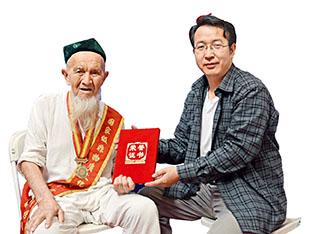
Wei Baoshan (right) with mulberry paper inheritor Tohti Barker.
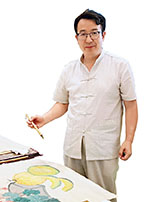
Wei Baoshan.


Cultural and creative products made of mulberry paper.
TASTING ILI
Collision of past and present

Gulendem Ice Cream Shop.
Food can represent the past, mark the places we visited and remind us of the people we met, so each new bite revives warm memories.
Xinjiang, a Good Place is a popular song known across China. If you ask Wang Meng, a famed writer who spent many years in the region during the tumultuous 1960s and 70s, Ili in western Xinjiang is the best of the best. Its food is one reason he rates it so highly. The frontier area is saturated with the aroma of fresh grass, flowers, butter tea, and various delicacies including toasted Baozi (meat stuffed bun), grilled mutton, and pilaf.
Gulendem Ice Cream
Many young people flock to Yining, capital of Ili Kazak Autonomous Prefecture, to try ice cream from the internet-famous store Gulendem. The store’s name means “flower of ice and snow” in the local language and was inspired by the heroine in Visitors on the Icy Mountain, a 1963 film. The ice cream shop is hidden behind a wooden gate in a courtyard complex on Liguang Street. Its décor blends ethnic and modernist styles, featuring white ironworks on the porch, gorgeous carpets with traditional patterns, sofas, a piano, and stacks of books. Many visitors eagerly start snapping pictures long before any ice cream is served.
The owner is young Ili native Wang Cheng. He operated a café and tea house before opening this business. “I grew up eating the local ice cream, a taste that has stayed with Ili people,” he said. His favorite was made by an old Ozbek man named Abdullah. The brand has been sold in Yining for over a century.
Wang used to sell Abdullah’s ice cream at his café, but supply vanished after the old man passed away. “Its taste represented warm childhood memories for many Ili people,” he sighed. “I wanted to share it with more people.”
The ice cream maker’s death plunged his family into financial difficulties. Upon learning of their situation, Wang reached out to them with a win-win cooperation proposal. “They still had the ice cream making skills,” Wang revealed. “I was able to offer them a platform on which to practice it to earn a stable source of income.”
The ice cream is easier eaten than made. The manual process must be handled with high precision to nail the unique, superb flavor. The ingredients are all natural, and the recipe has been adapted to integrate the best of Ozbek, Uygur and Russian ice cream flavors.
The crowds start to mushroom after lunch hour. It sells 1,000 servings (300 kg) of ice cream every day and still cannot meet demand. Tourist Li Yatong was on her second visit to the store when I met her. When she came in the late afternoon the previous day, they had already sold out. She and her friends had to order yogurt and snacks instead and were disappointed they couldn’t try the ice cream they heard so much about. Upon overhearing their lament, Wang Cheng managed to scrape together one serving for them to share. “The taste was amazing, so we had to get here early this morning,” Li grinned over a bowl of ice cream sprinkled with nuts and jam.
“The milk, eggs, and sugar are all from Ili,” noted Wang. “So is the jam—apricot jam, wild plum jam, black currant jam, and raspberry jam. The nuts are also locally sourced.” Wang hopes his ice cream can help promote Ili produce to the rest of China. In the future, he plans to set up a display space at his stop where Abdullah’s heirs can demonstrate the traditional making process of ice cream so customers can learn more about the culture behind it. He is also researching selling the ice cream to inland cities through cold chains.
Cooperative Restaurant
At lunch hour, deputy township magistrate Dostjan Jumehan welcomed customers to Baijia (literally “Hundred Families”) Restaurant. It is in Wuzongbulake, a rural community in Qapqal Xibe Autonomous County, Ili, for people relocated under the poverty reduction program. Contrasting most restaurants, Baijia doesn’t have a kitchen. Dishes are prepared in the homes of local villagers, who serve as the chefs, and everything on the menu is a local specialty.
Dostjan served a plate of steaming hot hand-served mutton. Mutton, sheep milk, and derivative foods dominate the Kazak diet, and hand-served mutton is a popular dish of the ethnic group. The meat tastes the best when 70-80 percent done, just before falling off the bones. Broad noodles at the bottom of a bowl with mutton and onions on the top is a Kazak dish called “naren.”
“I don’t live here, but the villagers are as close as family,” said Dostjan in a booming voice. “They grew up living in the mountains, wholly dependent on the weather to survive, but now live as comfortably as people in cities. I am happy for them.”
Buratijan Belkali, 56, cooks for the restaurant. “I was poor and could seldom eat meat all year round,” he said. “Now I live in a new house built by the government, own sheep, and make extra cash here. By selling my pilaf at this restaurant, I earn more than 7,000 yuan [US$1,043] a month. Life couldn’t be better.”
“The future will be better,” Dostjan rebutted, patting Buratijan’s back. He said that the restaurant’s operation was inspired by the sharing economy. Able-bodied villagers who did not seek employment out of the region were encouraged to establish a tourism cooperative, which has so far amassed 42 members. After a customer places an order, restaurant staff contacts a villager who excels at making the dish through WeChat or by phone, and rides a motorcycle to the villager’s home to bring it back. “In cities the food is delivered from a restaurant to a home, but here we take it from a home to the restaurant. Either way, the customer gets served.”
Dostjan is a witness to and driver of change in this rural community, with inhabitants from mountainous regions in Kanxiang Township. In 2001, he was appointed vice magistrate of the township. According to Dostjan, the old site of the community was halfway up the mountain. People subsisted by raising sheep, lived in adobe houses, walked a long way to fetch water, and cooked over firewood. Due to nearby mining activity, the ground was caving in. And they lacked modern transportation. A combination of several factors made the region uninhabitable.
The local government introduced a policy to relocate poor residents in 2013. In July of that year, Dostjan escorted representatives of the village to Wuzongbulake, the relocation site. “The herders were uneasy about leaving their long-time living environment,” he recalled. “But then, they saw the new homes with flushing toilets, showers, and other amenities, tried the convenient transportation, and realized that the whole community would come together. They became excited about the move.”
As the closest Kazak village to Yining, Wuzongbulake has become a hot tourist destination. “Alongside Kazak food, we sell produce, dairy products, and traditional embroidery works,” said Dostjan. “We sell whatever the villagers produce.” Last May, the cooperative shifted focus to developing the family economy and rural tourism with an aim to guarantee employment for all working-age villagers.
When the sun set, the night market lit up. People gathered at tables in small groups, smiles on every face. The inviting aroma of kebabs and melodious touting of its sellers drifted far in the breeze. So blew away another beautiful night in Ili.

Well-known Chinese TV presenters pose with the owner of Gulendem Ice Cream Shop Wang Cheng (first left, second row) and his staff.
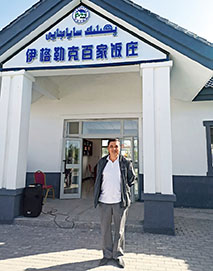
Dostjan Jumehan in front of Baijia Restaurant.