

 Copy Reference
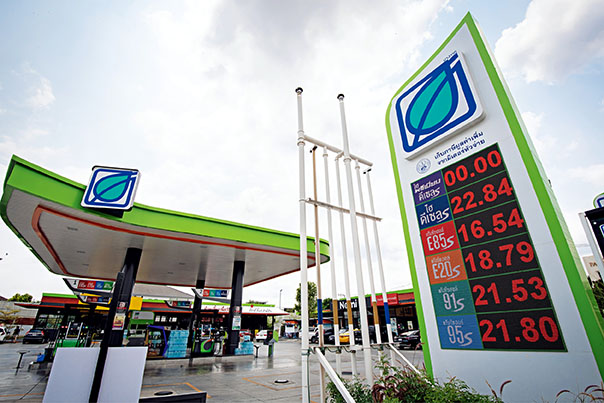
A gas station in Bangkok, Thailand, March 17, 2020. (NEWSCOM/VCG)
A big screen at the Ministry of Energy of Thailand displays blue and yellow lines representing existing pipelines in Thailand built in the 1990s.
In addition, a solid green line shows where a product oil pipeline is under construction in northeastern Thailand, and a dotted blue line represents another product oil pipeline in northern Thailand. They are the only two refined oil pipelines to be approved by the Thai government in nearly two decades, and both were built by the same Chinese company.
The refined oil pipelines are tremendously significant not only in improving Thailand’s energy security and promoting local economic and social development, but also in enhancing the connectivity between Thailand and other Southeast Asian countries such as Laos and Myanmar.
Dual Guarantee
Along Highway No. 201 from Bangkok heading northeast, several excavators and cranes were working on the side of the road. After anti-corrosion treatment, black and shiny steel pipes were hoisted into a pipe trench, welded, backfilled, and continuously extended forward. At a construction site in Changwat Chaiyaphum, rock drillers rumbled loudly as puffs of dust rose from a trench.
In July, Thailand’s rainy season was as wet as ever. Staff from China Petroleum Pipeline Engineering Co., Ltd. (CPP) Southeast Asia Project Management Department continued working in rain and extreme temperatures every day to keep advancing the pipeline project in northeastern Thailand.
“This stone needs to be broken before the trench can go any further,” said Prasit, supervisor in charge of the construction of the section. “The complex terrain, the hot and rainy climate, the difficulties with excavation, and formation of the silt and stone sections of the trench are the main hurdles. During construction, the Chinese company has overcome many difficulties such as high stone density and complex stratum, and the welding qualification rate has been maintained at above 96 percent, which evidences the strength of the Chinese company.”
According to Shan Xudong, manager of the CPP’s Thai company and project manager for the refined oil pipeline in northeastern Thailand, the project features a new oil pipeline, supporting oil stations, and tank farm terminal. Starting in Changwat Saraburi, the pipeline passes through five changwats (provinces) before arriving at Changwat Khon Kaen. The 342-kilometer-long pipeline includes a first station, a remote control valve room, a manual valve room, and a tank farm at the terminal.
Some nine storage tanks can be found at a construction site on the outskirts of Khon Kaen, a central city in northeastern Thailand. The tank farm at the terminal of the northeast pipeline will be completed in October 2021, enabling 20 northeastern changwats to receive oil directly.
“The oil price in the northeast is 0.5 Thai baht (US$0.02) higher than in Bangkok, so it costs me 35 baht (US$1.1) more to fill up here,” explained taxi driver Thongchai. “After the oil pipeline is completed, refined oil will be transported from the area around Bangkok to the northeast, which should stabilize the oil supply in more than 20 changwats and bring the price down.”
In 2017, the CPP began to build a 574-kilometer oil pipeline in northern Thailand, which was planned to become the longest onshore oil and gas pipeline in Thailand’s history. When it is completed, product oil will be transported from tank farms around Bangkok in central Thailand to the north, which will greatly help the development of northern Thailand.
During construction of the oil pipeline in northern Thailand, the CPP achieved “Chinese speed” by welding 90 kilometers of pipeline in a month, another record of pipeline construction in Thailand. The one-time pass rate of welding has always remained above 97 percent, a record of “thousands of welded joints without repairs.”
Energy Cooperation for Connectivity
Thai Prime Minister Prayut Chan-o-cha noted that ASEAN is facing multiple challenges in the energy sector. ASEAN’s demand for energy is rising alongside the region’s rapid social and economic development. The Belt and Road Initiative (BRI) is conducive to promoting international cooperation.
“The world is now at an important stage of energy development,” said Prayut. “Cooperation among countries in applying new energy technologies and solidifying development patterns will ensure more stable and active energy development.”
Sontirat Sontijirawong, former energy minister of Thailand, said that the refined oil pipelines built by the Chinese company are highly significant in terms of improving the oil supply in northeastern and northern Thailand, promoting local economic and social development, and strengthening connectivity between Thailand and neighboring countries such as Laos and China.
In addition to supplying refined oil to the northeastern region of Thailand, the pipeline in northeastern Thailand will also be extended to Laos. Gasoline and diesel consumption in the market of Laos is entirely dependent on imports, and the main sources are Thailand and Vietnam. At present, imported petroleum from Thailand must be transported 700 kilometers by truck from Bangkok to Vientiane. The northeastern region of Thailand is adjacent to Laos. The oil depot in Changwat Khon Kaen is only 250 kilometers from Vientiane, 280 kilometers from Savannakhet (Laos), and 400 kilometers away from Pakse (Laos). The product oil pipeline in northeastern Thailand will greatly shrink the delivery cycle, save logistics costs, increase the volume of oil transported, and maintain the stability of oil supply.
At the groundbreaking ceremony for the product oil pipeline in northeastern Thailand held last February, an agreement to promote extension of the northeast pipeline to Laos was signed. A senior executive from the Thai Pipeline Network Company Limited (TPN) noted that the pipeline can be connected to Vientiane in the future as well as to China. The refined oil pipeline in northern Thailand can also benefit Myanmar. It could ultimately connect Thailand’s Changwat Tak to Myanmar’s Kayin State.
Sontirat Sontijirawong dubbed connectivity an important factor to promote sustainable development. The BRI cooperation can effectively reduce logistics costs, facilitate personnel exchange, and promote innovative exchange and practice sharing. Through cooperation, Thailand and China will jointly promote connectivity and sustainable development in the Greater Mekong Subregion and even larger areas.
High-quality Development
Over the past seven years since the BRI was introduced, many iconic energy projects have been implemented and are delivering economic and social benefits to people of all involved countries. In April 2019, the Belt and Road Energy Partnership (BREP) was formally established. It is committed to principles of extensive consultation, joint contributions, and shared benefits, with a mission to promote mutually beneficial cooperation in energy, help countries jointly address issues related to energy development, achieve common development and prosperity, and make positive contributions to constructing a community with a shared future for mankind. The BREP will also work to promote intergovernmental policy exchange and communication on cooperation goals, build bilateral and multilateral project cooperation and technology exchange platforms, and propel pragmatic cooperation in the energy sector.
Driven by industrialization and urbanization, the development needs of transportation and energy sectors in the Belt and Road countries are significantly higher than those of other industries. The strong demand for development of the transportation and energy sectors will inject vitality into the region’s international infrastructure cooperation. The energy industry, led by power infrastructure construction, has also played an important role in promoting the development of international infrastructure. Electricity consumption in the industrial, commercial, and residential sectors of various countries has increased, and the upgrading of electrification construction has effectively stimulated demand for further energy construction in Belt and Road countries.
At the same time, implementation of sustainable development concepts in infrastructure construction has been helping the concept of green development and green infrastructure become more widely recognized by the international community. Demand for clean energy such as wind, solar, and nuclear has continued to increase.
“The fact that the only two main refined oil pipelines planned by the Thai government in the past 20 years were built by a Chinese company is also promoting the BREP and contributing to building a community with a shared future for mankind,” Shan Xudong said.
Thanks to a huge population, fast-growing economic strength, and a relatively favorable infrastructure construction environment, demand for infrastructure in Southeast Asia, especially for fields of energy and transportation, has continued to grow.
Chaiwat Wanishwattana, editor-in-chief of Thailand’s Thansettakij Newspaper, said that energy can provide impetus for achieving peace and prosperity in all countries. Southeast Asian countries support regional infrastructure construction if it can achieve benefits for all participants, promote security of energy supply, provide impetus for economic and social development, and promote cooperation for mutual benefits and win-win outcomes.
“As BRI construction enters a new stage of sustained development, future energy cooperation will create more opportunities for all parties and help BREP facilitate higher-quality development,” Chaiwat Wanishwattana said.
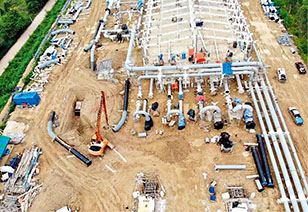
Construction site of a natural gas pipeline project in Ratchaburi, Thailand, 2019.
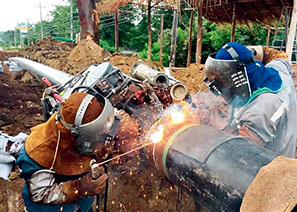
Thai employees weld a section of the refined oil pipeline in northeastern Thailand, 2019.
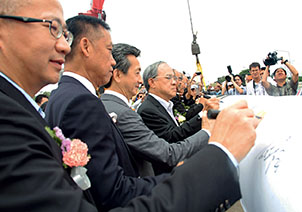
Thai officials and business representatives sign the first welded joint at the groundbreaking site of Thailand’s longest refined oil pipeline in Changwat Sing Buri, Thailand, on September 7, 2017. (WANG YONGJUN)
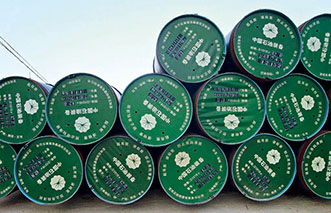
Oil pipeline sections waiting for assembly.