

 Copy Reference
Guangdong, a coastal province in southern China, has implemented three programs to tackle employment issues: The “Cantonese Cuisine Cooks” program provides subsidies of 10,000 yuan (US$1,468) to people who run agritainment businesses or restaurants, the “Household Service” program covers costs for poor households seeking to start a business, and the “Guangdong Technicians” program helps students from poor families get trained and existing technical personnel sharpen their skills.
More and more people are realizing the importance of professional skills. Programs like these three create concrete and popular avenues for the people to escape poverty.
Cantonese Cuisine Cooks
“If I hadn’t learned to cook Cantonese food, I would still be working part-time in a factory, and my family would be worrying about money all the time,” said Jia Ming, operator of a restaurant in Maoming in southwestern Guangdong. Free training under the Cantonese Cuisine Cooks program two years ago turned his life around.
Cantonese cuisine is one of the eight major cuisines in China and maintains consistent popularity. The Cantonese Cuisine Cooks program in Guangdong provides short-term training to help people land jobs quickly and start business easily. It has been effectively arousing enthusiasm among rural poor households and playing a lead role in the battle against poverty. Some 50 poor house holds lacking professional skills received free Cantonese Cuisine Cooks training in Zhilan Village, Zhanjiang, a city at the southwestern end of Guangdong. Through short-term training, the villagers quickly became skilled cooks.
Villager Bu Wei, who had enjoyed cooking and baking for some time, improved his culinary skills dramatically through the Cantonese Cuisine Cooks training program. Bu was quickly hired as a night-shift cook at a monthly-salary of 4,500 yuan (about US$661).
Led by Cantonese cuisine master Gao Fei’s studio teaming up with Yu Tang Fu Enterprise Development Co., Ltd. and Hutoupo vegetable planting base in Suixi County, the Cantonese Cuisine Cooks Vegetable Base was established. Through the vegetable base, Hutoupo Village has sold 115,000 kilograms of agricultural products worth 1.168 million yuan (US$171,510), and increased the annual income of poor households from an average of 5,200 yuan (US$764) to 11,000 yuan (US$1,615), effectively lifting all of Hutoupo, once a provincial-level poverty-stricken village, out of poverty.
Industrialization of agriculture as the Cantonese Cuisine Cooks Vegetable Base does has helped alleviate poverty across Guangdong Province. Cantonese Cuisine Cook Zhang Enhua set up an agricultural company specializing in production and sales of Canna edulis Ker powder, a highly desired ingredient for natural jelly, in Xinyi, a county-level city in Guangdong. Today, the annual output value of Canna edulis Ker powder exceeds 90 million yuan (US$13.2 million). The price of Canna edulis Ker powder increased from more than 20 yuan (US$3) per kilogram to current 100 yuan (US$15) per kilogram.
Guangdong Technicians
Chinese student Luo Liping from Guangdong Technician College of Light Industry won a silver medal in “commodity display technology” at the 45th WorldSkills Competition (WSC) in Kazan, Russia, in 2019. It was the best finish by a student from an Asian country since the WSC was first organized.
Luo Liping hails from a poor family. By learning a skill, she settled into a stable job and improved her entire family’s living standards, but also won honor for China in the form of a WSC award.
Many students from poor Guangdong families like hers have been learning skills that enable them to improve the living standard of their families.
In recent years, the Guangdong Technicians Program has been heavily promoted. Both fighting poverty within Guangdong Province and providing assistance to other provinces have yielded fruitful results.
Xu Shibao, an impoverished student from Yunxi County in Hubei Province, won second prize in the final of the National Vocational Skills Competition of Intelligent Building and Elevator Installation and Maintenance. Yang Shuai, a student from Qiannan Bouyei and Miao Autonomous Prefecture of Guizhou Province who had benefited from targeted poverty alleviation efforts, founded two auto repair factories with monthly turnover of more than 200,000 yuan (US$29,368). Ye Shengbing, now monitor of Class G3 of Automobile Technical Service and Marketing, was enrolled at Shenzhen Second Senior Technical School in 2016 as a targeted poverty-relief student from Shanwei City of Guangdong. Stable monthly income of more than 10,000 yuan (US$1,468) enabled Ye to marry and settle in Shenzhen.
Guangdong Lingnan Modern Technician College (LNMTC) cooperated with JD.com, the largest online retailer in China, to set up a rural e-commerce poverty alleviation class to improve skills of poor students in rural areas. According to LNMTC executive Huang Keming, students from the e-commerce poverty alleviation class were recruited to form an e-commerce team and market products on JD.com. Led by Wang Yingjin, a student from Dujiang Town of Sandu Shui Autonomous County, Guizhou Province, the project has so far delivered more than 8,000 products from 70 companies in five regions. The team now sells nearly 60 different products, more than half from ethnic minority areas.
Household Service
The Household Service Program is a zero-threshold project to improve living standards. The short-term training programs enable students to quickly grasp job skills while improving the quality of workers so they can land jobs quickly.
Zhu Quanhua, 46, is an ordinary woman from Yingtou Village, Sihui, a county-level city in central Guangdong. She has little education and previously did not earn much from odd jobs. After participating in the “Household Service” childcare training and maternity matron training classes, Zhu was certified as a maternity matron. Her monthly income has risen from 4,000 yuan (US$587) three years ago to more than 10,000 yuan (US$1,468) this year, and her customer base has expanded from Sihui to Guangzhou, Shenzhen, Foshan, and other places. As her income increases, her domestic situation has dramatically improved.
“Now that I have more money, I’m planning to renovate my house next year,” said millennial Chen Jiaoyan. “The Household Service Program has given me strength, the biggest change in my life.” Chen’s family back in Linzhai Village of Xuwen County, Zhanjiang, was very poor. Chen was hired after completing training and a job interview on March 5 of this year. She is now booked until April 2021 and expected to earn 71,000 yuan (US$10,426) this year.
The Household Service Program sprouted from villages and reached cities, driving development of the housekeeping industry in surrounding towns. The Wuchuan Household Service Incubation Base is an example. It has successfully attracted military veterans, returning college graduates, and poor households to join in to help local poor people escape poverty and embrace prosperity.
After completing Household Service training, Li Qiuchan mobilized and encouraged poor households and women in surrounding areas to try the training and recruited a household service team of nearly 700 people.
Advancement of Cantonese Cuisine Cooks, Guangdong Technicians, and Household Service programs is meeting the needs of people to pursue high-quality life, producing qualified laborers, and providing effective ways to stabilize and guarantee employment. Guangdong has reportedly carried out “Cantonese Cuisine Cooks” training a combined 54,000 person-times and “Household Service” training 380,200 person-times. The province now has an estimated 13.03 million skilled professionals, including 4.29 million highly-skilled technicians.
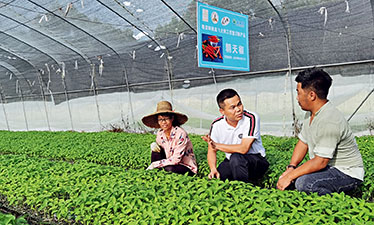
An executive (center) from Cantonese Cuisine Master Gao Fei’s Studio instructs farmers on vegetable growing at the Cantonese Cuisine Cooks Vegetable Base.

Gold-medal winners from Guangdong Province at the 45th WorldSkills Competition pose for a group photo.
L0051.T002.JPG
Guangdong has reportedly carried out “Cantonese Cuisine Cooks” training a combined 54,000 person-times and “Household Service” training 380,200 person-times. The province now has an estimated 13.03 million skilled professionals, including 4.29 million highly-skilled technicians.