

 Copy Reference
Walking down certain streets in Hanoi can feel like taking step after step towards economic prosperity. Only two decades ago, Hanoi was filled with aging buildings, but now Vietnam has risen from one of the poorest countries in the world to a middle-income country. Vietnam maintains 6-7 percent economic growth every year now. This growth is driven by Vietnam’s large and well-educated labor force.
Education in Vietnam
Alongside its economic success, Vietnam developed its educational institutions throughout the last 20 years. With a flourishing economy, the Vietnam government was able to provide greater education funding to raise the country’s literacy rate, which now measures over 90 percent. Primary school enrollment rate is at 96 percent. On the surface, labor productivity has skyrocketed. Since 2008, labor productivity in Vietnam has increased by 22.5 percent. Only education could produce the skilled workers necessary to increase Vietnam’s labor productivity so much. When economic growth alone can’t effectively produce enough skilled workers, improving education certainly can.
Vietnam’s economic success is closely linked to its success in reforming its education system. The country formerly lagged terribly in terms of educated adults. According to Vietnam’s Ministry of Education and Training (MoET), at the middle of the 20th Century, 95 percent of Vietnamese people were illiterate, and the figure was even worse among ethnic minority groups. MoET acknowledged the seriousness of the educational problems and tackled them head on.
The first step Vietnam took to eradicate illiteracy was to target literacy among 15 to 60-year-olds. With assistance from international NGOs such as UNESCO and Actionaid International and local support from the farmers’ union, women’s union, and youth union, Vietnam utilized every available resource to increase its literacy rate. MoET organized 11,060 community-based learning centers to tackle illiteracy through reading and writing classes. Different provinces adopted different plans to eliminate illiteracy. Places with many ethnic minority inhabitants found innovative ways to encourage everyone to speak, read, and write Vietnamese. By 2000, Vietnam’s literacy rate among the 15-60 demographic reached about 98 percent, an impressive success by any standards.
Various scholars, governmental bodies, and businesses in Vietnam have claimed the country needs a more skilled workforce to attract greater numbers of multinational corporations and industries to foster increased opportunities to facilitate economic growth. Although the size of the labor force is increasing, most of the workers need minimal education and vocational training. The General Statistic Office of Vietnam’s latest survey of Vietnamese workers shows that non-skilled laborers still account for 77 percent of the total force, while university graduates only account for less than 10 percent.
Vietnam’s skilled labor pool is small, but demand for educated workers is increasing exponentially. Alongside governmental officials, business leaders hold similar opinions. The need for skilled labor is particularly dire in business. The Hanoi office of China Southern Airlines requires employees to hold an undergraduate degree.
A Long Way to Go
To facilitate further economic growth and compete with other industrial nations, Vietnam needs to improve its educational system and enhance the skill of its labor force. How should Vietnam help its educational institutions facilitate economic growth? Over the next decade, Vietnam should focus efforts in three areas: reforming basic education to ensure equality, enhancing post-secondary educational programs to expand its skilled labor force, and developing new vocational programs to improve worker competency.
The top priority must be reforming secondary and primary education programs. Currently, only five years of primary education is considered mandatory—far too few for a middle-income country.
However, as more and more students enroll in secondary education, shortages of resources are becoming apparent—especially the lack of teachers nationwide. “Vietnam is currently short of 76,000 teachers considering the increasing demand,” said Education Minister Phung Xuan Nha. “We estimate that primary, secondary, and high schools lack 19,000, 10,000 and 3,100 teachers, respectively.” Secondary education is not only grappling with a lack of teachers, but also inequality between subjects. Mathematics, science, social studies, and language are more valued than arts. For Vietnam to fully overhaul primary and secondary education, the country needs to address the nationwide shortage of teachers and inequality between teachers.
The differences in available educational resources between urban areas and rural places inhabited by mostly ethnic minority groups are also strikingly high and a key cause of migrant crisis. Urban residents enjoy relatively solid education and abundant skilled labor opportunities, whereas rural communities offer meager education choices, forcing many young people onto treacherous journeys abroad. Leveling the playing field between urban and rural children is a challenging task facing MoET.
Secondly, Vietnam needs to reform its universities and colleges to provide skilled labor directly to fields most in need. Vietnam is currently home to 234 universities and 185 colleges, and college attendance has doubled since the 1990s. On the surface, it looks like Vietnam’s post-secondary education is developing and improving rapidly. However, the capacity of these colleges and universities is a mere 600,000, leaving a significant supply gap compared to the demand for post-secondary labor. The shortage of skilled labor and surplus of unskilled labor is a serious issue that begs for expansion of post-secondary education institutions.
Two approaches could be taken to address the issue. One approach is to expand existing universities to give them more capacity to admit students. The other is to establish more universities across the country, which would also provide more opportunities to attend. Primary, secondary, and undergraduate education aren’t the only avenues to address a lack of skilled labor. The most direct way to train students is to improve vocational education.
Putting students through college is expensive for both families and the government in terms of grants and subsidies. It also takes a long time to achieve the objectives. Vocational education can be an attractive alternative because it is much less expensive than college and enables students to enter workforce at a younger age, making it a preferable solution for many families.
In 1978, Vietnam’s government split vocational education from the Ministry of Labor to form the General Department of Vocational Training. The Government of Vietnam manages and finances all skills training, with particular focus on training workers, technicians, and managers for state-owned enterprises. According to “Vocational Education & Training in Vietnam” under the Development of a Network of Vocational Colleges, Vocational Secondary Schools, and Vocational Training Centers, the number of students in technological schools who receive vocational training is set to increase by 10 percent annually. A whopping 62 percent of Vietnamese employers claim difficulties filling in job vacancies. Many companies in Vietnam prioritize skills over a bachelor’s degree, so focusing on vocational education is arguably a better solution than building or expanding universities.
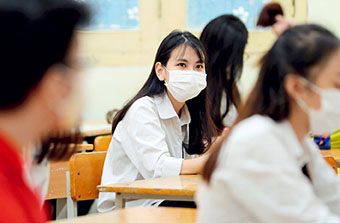
Masked students attend class on May 4, 2020, the first day schools in Hanoi, capital of Vietnam, reopened after the COVID-19 outbreak. (XINHUA/VNA)
L0062.T001.JPG
With a flourishing economy, the Vietnam government was able to provide greater education funding to raise the country’s literacy rate, which now measures over 90 percent. Primary school enrollment rate is at 96 percent.
L0062.T002.JPG
By 2000, Vietnam’s literacy rate among the 15-60 demographic reached about 98 percent, an impressive success by any standards.
L0062.T003.JPG
“Vietnam is currently short of 76,000 teachers considering the increasing demand,” said Education Minister Phung Xuan Nha. “We estimate that primary, secondary, and high schools lack 19,000, 10,000 and 3,100 teachers, respectively.”